
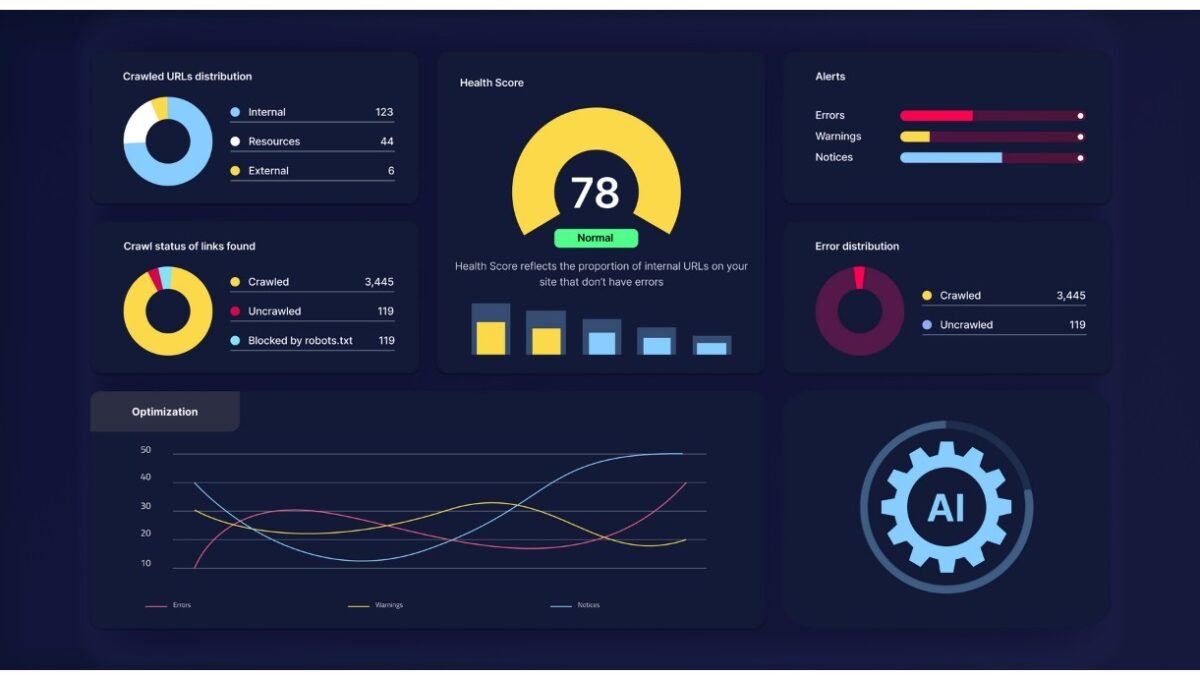
Technical SEO audits are the broccoli of digital marketing — essential, unglamorous, and often skipped. So can AI do technical SEO audits? The honest answer: AI can’t crawl your site, but it can think about crawl data better than most humans. The winning formula is real audit tools for data + AI for analysis. Here’s exactly how that works.
Can AI do technical SEO audits? The Honest Answer
Let’s be clear about the limits. AI cannot: crawl your website (it doesn’t browse at scale — you need Screaming Frog, Sitebulb, or cloud crawlers), measure Core Web Vitals (needs real user data from PageSpeed Insights / CrUX), check indexation status (that’s Google Search Console’s job), or verify structured data at scale (needs testing tools). Anyone selling “fully AI technical audits” without these data sources is selling fiction. The data must come from real tools. Always.
What AI Does Brilliantly (The Analysis Layer)
Here’s where it gets powerful. Feed AI the output of your audit tools and watch it work:
- Prioritization: “Here are 247 technical issues from our crawl [paste categorized summary]. Prioritize by SEO impact × effort, and explain the top 10 in plain English for my developer.” This alone is transformative — audits fail when everything looks equally urgent; AI triages.
- Plain-English translation: “Explain these hreflang errors like I’m a marketing manager, with what to tell the developer.” Bridging the marketing-dev gap that kills most audit implementations.
- Fix instructions: “For these 12 redirect chains, write specific fix instructions including the correct redirect targets.” Actionable, not just diagnostic.
- Pattern detection: “Analyze these 500 404 errors — what patterns do you see? Are they from a specific site section or migration?” AI spots patterns in bulk data fast.
- Log file analysis: “Here’s our server log summary — how is Googlebot spending its crawl budget? Any waste to fix?” Crawl budget insights from data humans glaze over.
- Competitive technical benchmarking: “Compare our Core Web Vitals against these 3 competitors [paste data] — where are we losing?”
The Practical Audit Workflow
- Crawl with a real tool (Screaming Frog for small sites, Sitebulb/cloud for large).
- Export the issue summaries — categorized, not raw URL dumps (AI context windows are finite; summarize first).
- AI-prioritize: impact × effort ranking with plain-English explanations.
- AI-draft fixes: specific instructions per issue type for your developer.
- Human verify: spot-check the AI’s recommendations — especially redirect targets and robots.txt changes, where AI errors have sharp teeth.
- Implement, re-crawl, compare. The loop that actually improves things.
What to Watch Out For
Hallucinated technical advice: AI occasionally invents directives or misstates how Google handles edge cases. Verify consequential recommendations against Google’s documentation. Context window limits: don’t paste 50,000 URLs — summarize and categorize first, then analyze the summaries. False confidence on JavaScript SEO: rendering issues are nuanced; AI analysis of rendering problems needs human SEO expertise alongside. The “audit” that’s just ChatGPT guessing: if no crawl data was involved, it’s not an audit — it’s speculation. Demand the data layer.
Pair with AI keyword research and AI-assisted content for the full SEO system, within the digital marketing playbook.
Real Audit Example: What AI Found That Humans Missed
A 5,000-page e-commerce site ran quarterly manual audits — competent, thorough, human. Then they added AI analysis of the crawl exports. What the AI caught: a pattern of 340 orphaned product pages (no internal links) clustered in two categories — the human auditor had seen the 404s individually but missed the pattern. A hreflang implementation where 60% of alternate URLs returned soft 404s — individually plausible, collectively broken. Crawl budget waste: Googlebot spending 40% of crawls on faceted navigation URLs with parameters — the log analysis made the waste visible in a way raw logs never had.
What the humans caught that AI missed: a JavaScript rendering issue where the AI’s recommendation (based on the crawl data) would have broken the checkout flow — domain knowledge the AI lacked. A business-priority call: the AI correctly prioritized a technical fix, but humans knew the affected section was being redesigned next quarter — effort better spent elsewhere.
The lesson: neither alone was sufficient; together they were excellent. The AI found patterns in bulk data; the humans applied business context and caught the dangerous recommendation. The workflow that stuck: quarterly crawl → AI analysis and prioritization → human review meeting (30 min) → implementation sprint. Total human time: 4 hours/quarter for an audit quality that previously took 40. That’s the honest story of AI technical SEO: not replacement, but a 10x leverage on human expertise — with the human still essential at both ends.
The Takeaway
AI can’t crawl your site, but it’s exceptional at analyzing crawl data: prioritizing issues, translating them for stakeholders, drafting fixes, and spotting patterns. The workflow is real tools for data, AI for analysis, humans for verification. That’s not a compromised audit — it’s a better one than most humans produce alone.
Tooling: Screaming Frog for crawling, Google’s SEO docs for verifying AI recommendations.



