
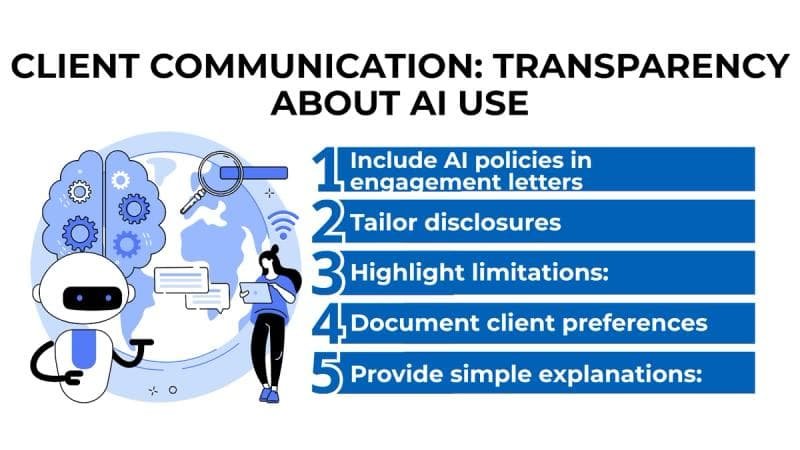
“Should I tell my clients I use AI?” — the question underneath is really about trust, professionalism, and whether disclosure helps or hurts your business. How to disclose AI use to freelance clients ethically? The short answer: yes, disclose — but how you frame it determines whether clients see it as a strength or a confession. Here’s the ethical framework plus the practical scripts.
How to disclose AI use to freelance clients ethically: What Actually Works
Required (tell them, clearly): when the contract specifies human-only work; when AI generates substantive creative content the client believes is original (a “brand voice” article that’s 90% AI-drafted); when the client explicitly asks about your process; in regulated contexts (legal, medical, financial content) where AI involvement affects liability. Strongly recommended: when AI does significant portions of deliverables; when starting new client relationships (set expectations early); when your marketing implies otherwise (“hand-crafted,” “written from scratch”).
Judgment call: routine AI assistance — grammar checks, research help, first-draft scaffolding you heavily rewrite. Most professionals don’t disclose spellcheck; proportionally, light AI assistance falls in the same zone. The test: would the client feel misled if they found out? If yes, disclose. If genuinely no, it’s a tool like any other.
How to Frame It (Scripts That Work)
The confident professional (recommended default): “I use AI-assisted workflows in my process — AI handles research and first drafts, and I apply [X years of] expertise for strategy, refinement, and quality control. The result: faster turnaround and sharper work. Every deliverable gets my full professional review.” Why this works: it positions AI as your tool serving their outcomes — professional, transparent, benefit-led.
In proposals: include a brief process note — “My process combines AI-assisted research and drafting with expert human strategy, editing, and quality assurance.” Normalizes it as methodology, not confession. In contracts: a simple clause — “Contractor may use AI-assisted tools in service delivery; all deliverables remain Contractor’s professional work product subject to [revision/quality terms].” Clean, professional, protective.
What NOT to say: apologetic framing (“I hope you don’t mind, but I sometimes use AI…”) — signals you think it’s wrong. Defensive over-explanation — signals guilt. Hiding it entirely while implying otherwise — the actual ethical violation.
Handling Objections
“I want 100% human work.” Respect it — some clients will insist. Decide if you want the engagement at human-only pricing (charge more — it’s slower). Or decline politely; fit matters. “Will the quality suffer?” “My quality control process is the same regardless of tools — [describe your review process]. Here’s a sample; judge the work, not the workflow.” “Is my data safe?” Legitimate concern — explain your data practices: what tools, what data they see, confidentiality measures. Have a real answer ready. “Should I pay less then?” “You pay for the outcome and my expertise directing the process — the value is the same or better, delivered faster.” (See pricing AI-assisted work.)
The reassuring reality: most clients care far less than freelancers fear — especially when disclosure is confident and benefit-framed. And for the negotiation side: AI-assisted rate negotiation.
Disclosure Across Different Client Types
Enterprise clients: expect formal disclosure — procurement may require it. Put the AI clause in the MSA, describe your data handling, be ready for security questionnaires. Enterprise comfort with AI is high; enterprise process around it is formal. Match the formality. Small businesses: conversational disclosure usually suffices — “just so you know, I use AI tools in my process for research and drafting; everything gets my expert review.” Most small business owners respond with “oh cool” and move on. They’re buying outcomes, not auditing methods.
Agencies (white-label): disclose to the agency; let them decide what to tell their client. Your contract is with the agency — their disclosure policies govern downstream. Get it in writing that you’ve disclosed to them. Creative industries: higher sensitivity — discuss explicitly, especially for work marketed as original. “Here’s where AI assists and where my original creative direction leads” — draw the line clearly. Regulated industries: legal, medical, financial — maximum transparency, documented processes, and sometimes client-mandated restrictions. When in doubt, over-disclose.
The universal principle: match disclosure formality to the relationship’s formality, but never hide. A casual “here’s how I work” suits small clients; a contract clause suits enterprises. Both are disclosure. Neither is a confession. The freelancers who struggle with this are the ones treating disclosure as an apology — reframe it as professionalism and the right level follows naturally.
This week: write your disclosure statement — two sentences describing your AI-assisted process, confident and benefit-framed. Add it to your proposals and your website’s process page. Then use it on your next client call and notice the reaction: it’s almost always neutral-to-positive. The anxiety about disclosure lives entirely in anticipation; the reality is a non-event that builds trust. Write it once, use it everywhere.
The Takeaway
Disclose AI use confidently as professional methodology — AI assists, you direct and guarantee quality. Disclose clearly when it’s substantive or when asked; use contract language that normalizes it; frame objections around outcomes. Ethical disclosure isn’t a burden — it’s a trust-builder that differentiates you from freelancers hiding their process.
Ethics reference: Freelancers Union — evolving standards for freelance practice.




1 Comment