
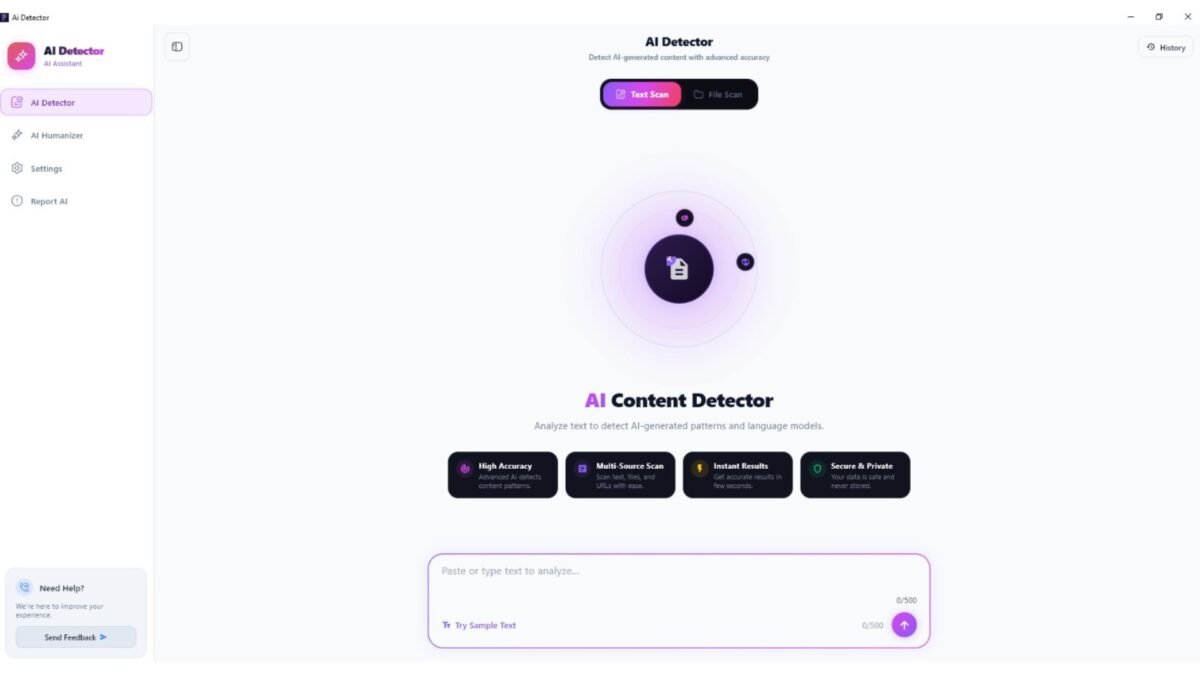
Want to know how to detect AI written content free? Good news: you don’t need to pay for expensive enterprise tools. Between free detector websites, built-in platform features, and old-fashioned close reading, you can build a solid detection workflow for zero cost. The catch — and I’ll be upfront about it — is that free tools have the same fundamental limitations as paid ones. Here’s how to use them wisely.
Free AI Detection Tools Worth Trying
Several detectors offer free tiers or are entirely free:
- Free web-based detectors. Multiple sites let you paste text and get an AI-probability score without an account. Quality varies enormously, so never rely on just one — run the same text through two or three and look for consensus.
- Open-source detectors. Researchers have released open models for AI text detection that you can run yourself. These require some technical comfort but give you transparency into how the scoring works — no black box.
- Platform-native features. Some publishing and LMS platforms have started integrating detection directly. If you’re a teacher, check whether your institution’s systems already include it before hunting for third-party tools.
- Chatbots themselves. Here’s a trick: paste suspicious text into a chatbot and ask “was this written by AI?” It’s unreliable as a verdict, but the model’s analysis of why it thinks so — pointing at specific stylistic patterns — is often insightful as a starting point for your own judgment.
How to Detect AI-Written Content Free: The Manual Method
Honestly? Your own reading is the most powerful free tool, and it costs nothing. Train yourself on the patterns:
- Uniformity. AI text has even sentence lengths, even paragraph lengths, even tone throughout. Human writing breathes — it speeds up, slows down, goes on tangents.
- Generality. “Various stakeholders should consider multiple factors” — AI loves sentences that sound substantive while saying nothing. Humans with real knowledge get specific.
- Vocabulary tells. Clusters of over-formal transitional words and flowery nature metaphors are statistical fingerprints.
- Missing humanity. No personal anecdotes, no strong opinions held loosely, no humor that actually lands, no references to specific lived experience.
- Fact-check the specifics. AI invents citations, statistics, and quotes with total confidence. Verifying two or three claims often settles the question faster than any detector.
Our broader guide on how to detect AI content goes deeper on manual techniques.
Getting the Most Out of Free Detectors
- Use long samples. Free or paid, detectors need 200+ words to be meaningful. Short texts produce noise.
- Cross-check across tools. If three free detectors all say 90%+ AI, that’s a real signal. If they disagree wildly, the text is genuinely ambiguous.
- Calibrate with known samples. Run text you know is human (your own writing) and text you know is AI through the tool. This shows you the tool’s baseline behavior and its bias — some free detectors flag everything, which makes their scores meaningless.
- Never act on a score alone. Especially with free tools, which tend to be less accurate than enterprise options. A score is the start of an investigation, not its conclusion. The false positive problem is severe — see our article on why AI detectors give false positives before making any accusation.
Free Detection for Specific Content Types
Essays and articles
Paste into 2–3 free detectors, then do the manual read. Check citations exist. Compare with the author’s other work if available.
AI images
Free reverse-image search can sometimes find the original AI post. Visually, zoom in on hands, teeth, text in the image, and background details — AI still struggles with these. Our guide to making AI images undetectable ironically documents exactly what to look for, from the other side.
Code
AI-generated code tends toward verbose, over-commented, textbook-style solutions. Tools for detecting AI code exist but are nascent; manual review by someone who knows the codebase remains the gold standard.
The Honest Limitations
Free detectors share every weakness of paid ones, sometimes worse: high false-positive rates, vulnerability to light paraphrasing, and rapid obsolescence as models improve. A free tool from last year may be nearly useless against this year’s models. Use them as one input among several, keep expectations modest, and put most of your trust in human judgment and process evidence (drafts, version history, the ability to discuss the work).
One more free technique worth mentioning: check the metadata. AI-generated images often carry generator metadata or C2PA provenance tags; documents sometimes reveal their history in file properties. It’s a long shot, but it costs nothing to look.
For more background, see Turnitin’s AI writing resources.
The Takeaway
You can absolutely build a free AI-detection workflow: a couple of free detector sites for initial screening, your own trained eye for the patterns, and fact-checking for confirmation. Just remember what you’re getting — a screening tool, not a lie detector. For high-stakes decisions, the free tier of evidence needs the same thing the paid tier does: human judgment making the final call.



