
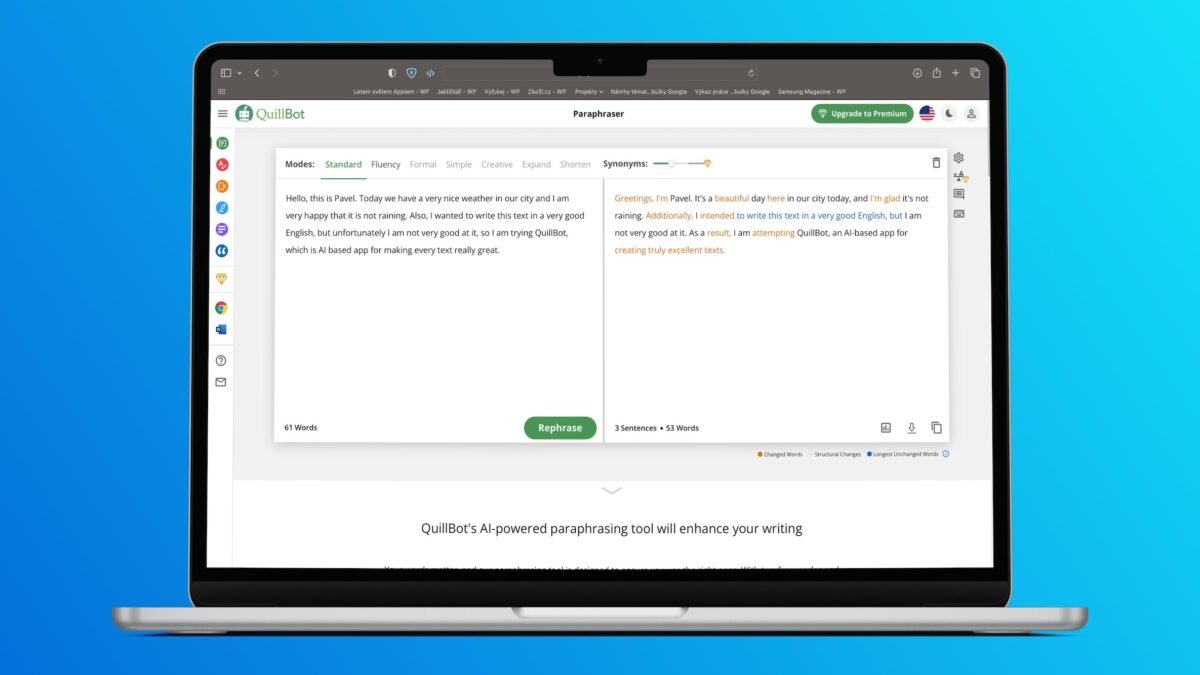
Does QuillBot bypass AI detection? This is one of the most-searched questions in the AI detection arms race, usually asked by students hoping to slip AI-generated essays past Turnitin. I’ll give you the straight answer: sometimes, partially, unreliably — and the full picture is more complicated than a yes or no. Let’s break down what’s actually happening when you run AI text through QuillBot.
What QuillBot Actually Does
QuillBot is primarily a paraphrasing tool. You feed it text, and it rewrites it — swapping synonyms, restructuring sentences, changing voice. It was built as a writing aid (and it’s genuinely useful for that), but it’s become famous as a way to “humanize” AI-generated text by altering the statistical patterns detectors look for.
The theory is sound-ish: AI detectors flag text with low perplexity (predictable word choices) and low burstiness (uniform sentence structure). Paraphrasing changes word choices and sentence structures, which can push the text’s statistics back toward the human range. Sometimes the detector score drops. Sometimes dramatically.
Does QuillBot Bypass AI Detection Reliably? No.
Here’s why “sometimes works” isn’t good enough:
- Detectors adapted. The major detection tools know about QuillBot. Many now specifically flag paraphrased AI text — Turnitin, for instance, has documented detection of paraphrasing-tool output. The arms race moved on; the trick is old news to the people building detectors.
- It degrades quality. Run AI text through a paraphraser and you often get something worse than either: awkward synonym swaps (“utilize” becomes “make use of” becomes something stranger), subtly changed meanings, and a weird stilted rhythm that’s arguably more suspicious to a human reader than the original.
- It’s inconsistent. The same text paraphrased twice gets different detector scores. You can’t verify it worked without running a detector yourself — and if you have detector access, you’re already in an adversarial loop with your institution.
- Newer detectors look deeper. The latest detection research focuses on semantic patterns and stylistic fingerprints that survive paraphrasing. Swapping synonyms doesn’t change the underlying “shape” of AI-generated argumentation.
The Academic Integrity Reality Check
Let’s be direct: using QuillBot to disguise AI-generated work as your own is academic dishonesty at most institutions, regardless of whether the detector catches you. The question “does QuillBot bypass AI detection” is really asking “can I cheat without getting caught” — and the honest answer is maybe, but the downside risk is enormous. Getting caught means failing grades, disciplinary records, and in some programs, expulsion. The expected value of this gamble is terrible.
If you’re struggling with writing, the legitimate uses of these tools are actually more helpful: our guide on humanizing AI text manually covers ethical techniques, and whether AI humanizers actually work examines the broader category QuillBot sits in.
What QuillBot Is Actually Good For
QuillBot is a fine tool used honestly:
- Rephrasing your own sentences when you’re stuck in a repetitive rut.
- Summarizing dense passages for study notes.
- Checking your writing — its grammar checker is solid.
- Non-native speakers polishing their own original writing into more natural English (though be aware this can itself trigger detectors — see our piece on why your essay gets flagged as AI).
The pattern: QuillBot helps when the ideas are yours and you want better expression. It fails — technically and ethically — when the ideas aren’t yours and you want disguise.
How Detectors Fight Back Against Paraphrasers
It’s worth understanding the other side of the arms race, because it explains why paraphrasing tricks keep failing. Modern detectors don’t just look at surface statistics anymore. Stylometric analysis examines deeper patterns — how arguments are structured, how ideas connect, the rhythm of reasoning itself — and these survive synonym-swapping intact. Some systems now maintain databases of known AI outputs and check for paraphrased matches, the same way plagiarism checkers match against source texts. And watermarking schemes embed invisible statistical signals in AI-generated text that persist through light paraphrasing. Each of these raises the bar for evasion, and none of them care which paraphrasing tool you used.
The practical upshot: every month you rely on a paraphrasing trick, the trick gets a little weaker. Students who built their strategy around QuillBot in 2023 found it far less effective by 2025. Betting your academic record on a depreciating trick is, to put it mildly, unwise.
Bottom line for anyone still tempted: the question isn’t really whether QuillBot works today — it’s whether you want your academic or professional future depending on a trick that gets weaker every semester. Learn the material, write it yourself, use AI tools openly for legitimate help. That’s the strategy that never expires.
For more background, see QuillBot’s official site.
The Takeaway
QuillBot sometimes lowers AI detector scores, but unreliably, at the cost of text quality, against detectors that have specifically adapted to it. As a cheating tool it’s a bad bet with catastrophic downside. As a writing aid for your own ideas, it’s genuinely useful. The distinction isn’t technical — it’s about whose thinking is in the text. And that distinction is exactly what your professors, clients, and employers care about, far more than any detector score.



