
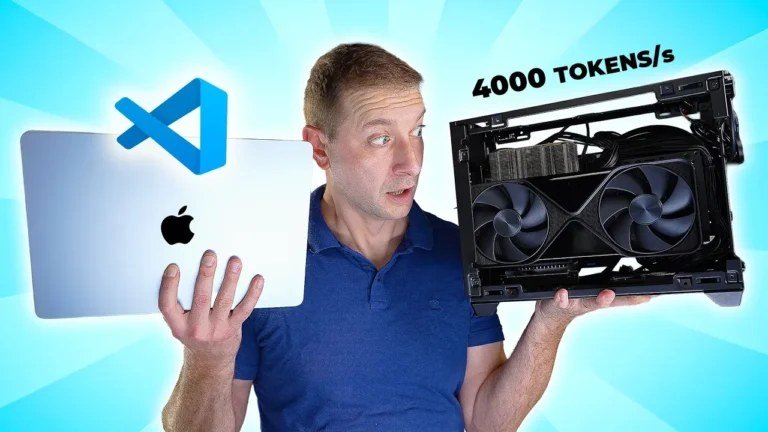
The pitch for local LLMs is seductive: buy a GPU once, run models free forever, never pay OpenAI another dime. But does running models locally cost less than API subscriptions? I ran the numbers for a few realistic scenarios, and the answer is the classic consultant’s favorite: it depends — mostly on how much you actually use it.
Does running models locally cost less than API subscriptions? The Honest Answer
Let’s price it honestly. A machine that runs a good 70B-class model comfortably (say, an RTX 4090 or a Mac Studio with 128GB unified memory) costs roughly $2,000–$4,000. Add electricity — a GPU rig pulling 450W for 8 hours a day costs maybe $30–50/month in most places. Amortize the hardware over 3 years and you’re looking at roughly $90–160/month in true cost, before your time spent maintaining it.
Compare that to API pricing: heavy ChatGPT Plus-style usage is $20/month. API usage for a developer doing serious work might run $20–100/month. A small team hammering an API could hit $500+.
The break-even picture
- Light user (a few hours/week): APIs win by a mile. $20/month vs. $100+/month amortized local. Not close.
- Heavy individual (all-day coding assistant): Roughly break-even around $100–150/month of API spend. If you’re burning $200/month in API calls, local starts looking smart.
- Team or product (millions of tokens/day): Local or self-hosted usually wins — API bills scale linearly with usage while your GPU costs stay flat.
What the Pure Math Misses
Cost isn’t the only variable, and for many people it isn’t even the deciding one:
- Privacy. Local means your code and documents never leave your machine. For regulated industries, this alone decides it.
- Latency and reliability. No rate limits, no outages, no “the API is slow today.” But also: you’re the DevOps team now.
- Model quality gap. Be honest: a local 70B model is excellent, but it’s not GPT-4-class on hard reasoning. You’re trading capability for control.
- Your time. Updating models, managing VRAM, debugging quantization issues — budget a few hours a month or you’ll resent the rig.
If you go local, serving it as an API endpoint lets all your tools share one model. And if you’re weighing a specific subscription, is Cursor worth $20/month is the exact kind of subscription math to run first. Businesses with private data should also read training AI on business data before deciding where models live.
Hidden Costs People Forget
The sticker math I did earlier misses a few things that bite real users. Your time is the biggest: expect 2–5 hours a month on updates, troubleshooting, and fiddling with quantization settings. At any professional hourly rate, that’s $100–500/month of invisible cost. If you enjoy tinkering, it’s a hobby; if you don’t, it’s a tax.
Electricity varies wildly — $15/month in some regions, $80+ in expensive ones for a 24/7 rig. Noise and heat are real quality-of-life costs: a GPU at full tilt sounds like a hair dryer and heats the room. Your office setup matters. Depreciation is sneaky too — that $3,000 GPU is worth half in three years, and new architectures keep raising the bar.
On the API side, the hidden cost is price volatility — providers change pricing, and heavy users occasionally get a surprise bill. Set up billing alerts and usage caps from day one. The honest total-cost comparison includes all of this, and for most individuals it still favors APIs until usage gets serious. The people who love local setups tend to value the privacy and independence as much as the money — and that’s a perfectly valid reason that no spreadsheet captures.
The Hybrid Setup Most People Actually Want
Here’s what experienced users converge on: both. A local model for the private, high-volume, latency-sensitive stuff — drafting with proprietary code, processing internal documents, offline work — and a $20 API subscription for everything needing frontier reasoning. Total cost: ~$100–150/month amortized plus the subscription. You get privacy where it matters and capability where it counts.
Set it up so the choice is automatic: route by content sensitivity, not by remembering to switch. Many tools support model fallback chains — local first, cloud on failure or on demand. Start with just the API subscription, add local hardware only when you can point to a specific pain (the bill, the privacy requirement, the rate limits) that it solves. Buying a GPU on vibes is how you end up with an expensive space heater. Buying one to solve a measured problem is infrastructure.
Your next step: check last month’s API bill (or estimate your usage honestly). Under $100/month? Stay on subscriptions and revisit yearly. Over it, or handling sensitive data? Install Ollama this weekend and try the hybrid setup before buying any hardware.
The Takeaway
Under ~$100/month of API spend, subscriptions win. Above that, or when privacy matters, local wins. Most individuals should start with APIs and only buy hardware when the monthly bill — or the privacy requirement — justifies it.
Model options: Ollama makes running local models genuinely painless to try before you commit to hardware.




1 Comment