
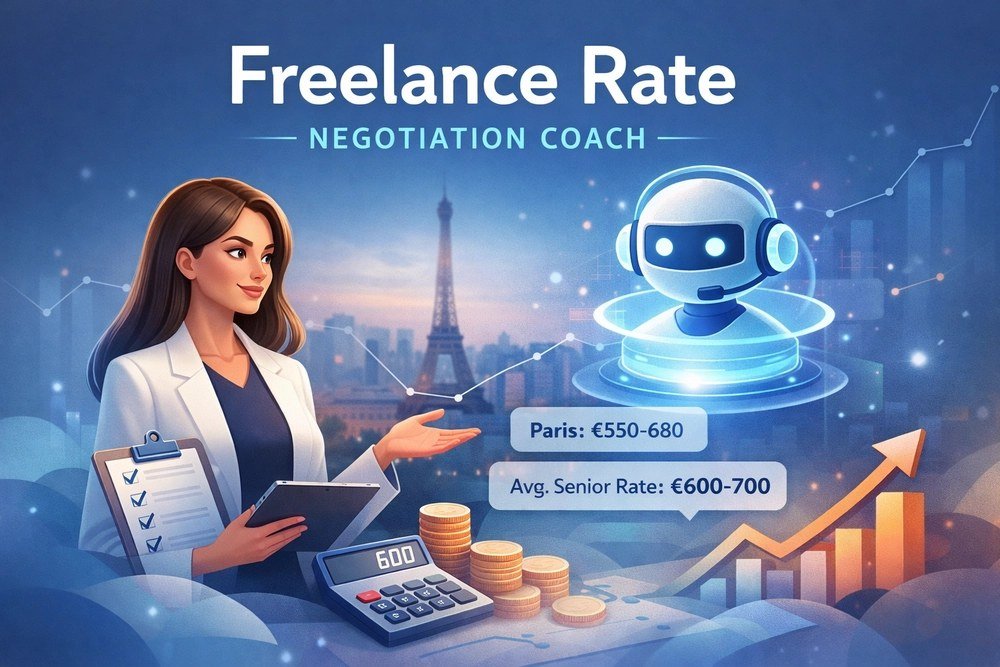
Rate negotiations are where freelancers leave the most money on the table — underpricing from anxiety, caving at the first pushback, not knowing what the market pays. Can AI help with freelance rate negotiations? Absolutely. AI is a tireless negotiation coach: it researches rates, drafts scripts, role-plays objections, and strategizes — all before you ever get on the call. Here’s how to use it.
Can AI help with freelance rate negotiations? The Honest Answer
Market rate analysis: “What do [your specialty] freelancers with [X years] experience charge for [project type] in [market]? Give ranges for beginner/intermediate/expert, with sources.” AI synthesizes rate surveys, platform data, and reports — directional, not gospel, but far better than guessing. Your floor calculation: “Help me calculate my minimum viable rate: monthly expenses [X], desired income [Y], billable hours realistic [Z], tax rate [W].” Know your walk-away number cold — negotiation confidence comes from knowing you can walk away.
Value quantification: “Help me quantify the value of [project type] for [client type]: what ROI do clients typically see? What does it cost them not to do this?” — the ammunition for value-based pricing (see pricing AI-assisted work).
2. Scripting and Strategy
Proposal language: “Draft the pricing section of my proposal: 3 tiers (good/better/best), anchor high, emphasize outcomes not hours, include a clear CTA.” Tiered pricing outsells single quotes — the middle tier becomes the obvious choice. Rate increase emails: “Draft a rate increase notice for existing clients: warm, professional, 15% increase, effective [date], grandfather option for [condition].” The email everyone dreads writing, done well in minutes.
Negotiation strategy: “Here’s the situation [describe: client, project, their budget signal, my rate]. What’s my negotiation strategy? Where’s my leverage? What concessions can I offer that cost me little but matter to them?” AI thinks through the game theory so you don’t have to mid-conversation.
3. Objection Handling (Role-Play Before the Call)
This is the highest-value use: role-play the negotiation. “Role-play as a cost-conscious client pushing back on my $5,000 quote. Be tough but realistic. I’ll practice my responses; critique me after each round.” Do 3 rounds. You’ll discover your weak responses before they cost you money.
Common objections, AI-drafted responses:
- “That’s over our budget.” → “I understand. Which parts of the scope matter most? Let’s prioritize — I can offer a focused phase 1 at [X] that delivers [core value], with phase 2 later.” (Never just discount; reshape scope.)
- “Can you do it for [lowball]?” → “I could do [reduced scope] at that investment. The full scope at [lowball] would mean cutting [specific quality element], and I won’t deliver work I’m not proud of.” (Polite spine.)
- “We need it cheaper/faster.” → “I can optimize for two of fast, good, cheap — which two matter most here?” (The classic triangle, still undefeated.)
- “AI means it should cost less, right?” → “You’re paying for the outcome and my expertise directing the process — delivered faster because of my methods, which is a benefit to you.” (See whether clients care about AI tools.)
4. Knowing When to Walk Away
The math: “This client wants [scope] for [price], requiring [hours]. My effective rate would be [X] vs. my floor of [Y]. Walk away or negotiate?” AI does the cold arithmetic when your emotions want the work. The red flags: “Here are this prospect’s messages [paste]. Any red flags? Scope creep signals? Payment risk indicators?” — pattern recognition from thousands of freelancer horror stories. The pipeline test: “I have [X] proposals out and [Y] weeks of runway. Should I take this lowball offer or hold out?” — AI weighs your actual situation instead of generic advice.
For winning the work worth negotiating over: winning clients with AI.
Negotiation Psychology (What AI Can’t Do For You)
AI prepares you brilliantly — but the negotiation itself is human, and psychology matters. Silence is leverage: after stating your rate, stop talking. The urge to fill silence with justifications or discounts is the #1 negotiation killer. AI can script your rate statement; only you can master the pause after it. Enthusiasm is information: “I love this project!” signals you’ll accept less. Be warm but measured until terms are set — then celebrate.
Never negotiate against yourself: “My rate is $5,000… but I could do $4,000…” — you just bid against yourself and lost. State the rate. Wait. Let them counter. Concessions must be traded, never given: “I can do $4,500 if we reduce the revision rounds to two and extend the timeline a week.” Every concession gets something back — this is the discipline AI role-play should drill into you. Likeability matters: people pay more to people they like. Be the freelancer clients enjoy negotiating with — firm, fair, warm, professional. Walk-away power is everything: the freelancer who can decline bad deals gets better deals. Build pipeline so you can walk away — which loops back to consistent prospecting. AI handles the preparation; psychology handles the room. Master both.
The Takeaway
AI coaches freelance rate negotiations through: market research (know your number), scripting (proposals, increases, responses), role-played objection handling (practice before the call), and walk-away math (cold arithmetic over warm anxiety). The freelancers earning the most aren’t the best negotiators naturally — they’re the best prepared. Now preparation takes 20 minutes.



