
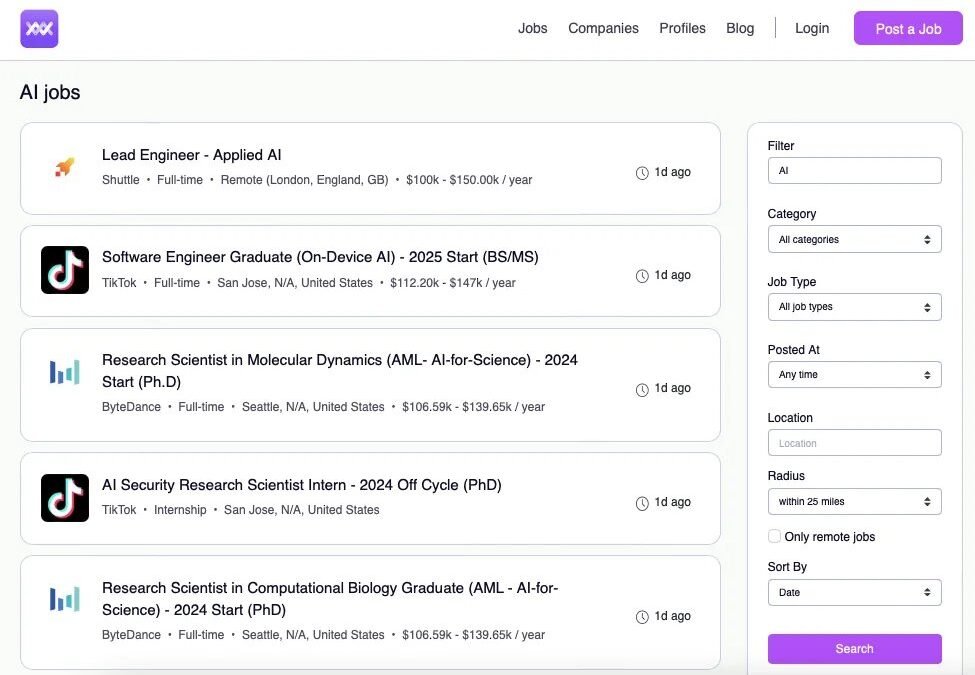
Okay, let’s talk about how to get hired at an AI startup. It’s one of those topics where everyone has an opinion and half of them are outdated. The landscape changed a lot in the last year, so if your knowledge comes from a 2024 blog post, you’re working with stale info. Here’s where things actually stand now.
We’ll cover the fundamentals, the mistakes that trip people up, and the small details that separate decent results from great ones. Let’s get into it.
How to Get Hired at an AI Startup: The Honest Version
If I had to compress how to get hired at an AI startup into one principle, it’d be this: start before you feel ready, and learn by doing. You can research for months, but a week of actual attempts teaches more than a month of reading. Make small bets, watch what happens, adjust. That’s the whole game.
What trips most people up with how to get hired at an AI startup isn’t difficulty — it’s vagueness. They never define what “working” looks like, so they can’t tell whether they’re making progress. Write down your target outcome in one concrete sentence before you start. Everything gets easier after that.
AI startups hire differently than big tech. There’s less process and more “can you actually do the thing.” Hiring managers at early-stage companies are usually the founders or a tiny team, and they’re pattern-matching for slope, not pedigree — they’d rather hire someone sharp and fast-learning than someone with a polished resume and no curiosity. For broader context, OpenAI’s business solutions is a solid reference on the wider landscape.
What to focus on first
- Build one real, demonstrable AI project — a chatbot, a fine-tuned workflow, an automation. Startups hire proof, not promises. A GitHub repo or live demo beats a certificate every time.
- Learn the fundamentals properly: how LLMs work, prompting, basic Python, and one framework. You don’t need a PhD, but you do need to understand what the tools are actually doing under the hood.
- Contribute visibly: write about what you learn, share projects, answer questions in AI communities. Startup founders notice people who are already part of the conversation.
- Target your applications ruthlessly. Ten tailored applications to startups whose product you genuinely understand will outperform a hundred generic ones.
- Talk to people inside AI startups before you apply — not to ask for a job, but to understand what problems they’re solving. Then position yourself as the answer to one of those problems.
Before we go further, a quick note: everything below assumes you’re starting from zero on the details but not on common sense. Adjust the pace to yours. If you’re short on time, skim the headings first — they tell the story on their own — then come back for the parts that matter to you.
What most guides get wrong about this
One thing candidates consistently underestimate: how much startups care about genuine interest in their specific product. If you can’t explain why their approach is interesting — not AI in general, their thing specifically — you’re just another applicant. Spend an hour actually using their product before the interview. It shows, and it gives you real questions to ask. If you want to go deeper on a related angle, I also wrote about What’s the leading AI roleplay software for business training — it pairs well with this.
- Skipping fundamentals to chase whatever tool is trending this month.
- Leading with enthusiasm instead of evidence. “Passionate about AI” means nothing; a shipped project means everything.
- Spraying identical applications at fifty startups. Founders can smell a mass application instantly.
- Only targeting famous AI labs while ignoring the hundreds of startups doing interesting applied work.
On compensation: early-stage AI startups often can’t match big-tech salaries, but the equity and the learning curve can be worth it if you pick well. Don’t just chase valuation headlines — look at the team, the runway, and whether you’d want the skills you’d build there even if the equity goes to zero. This connects closely to How does SEO work on AI mode, which covers the adjacent piece of the puzzle.
My honest take
My honest take? Most businesses don’t have an AI problem — they have a focus problem. AI amplifies whatever you point it at, including chaos. The companies quietly winning aren’t doing anything exotic; they’re just disciplined. One bottleneck, one pilot, real numbers, repeat. If that sounds boring, good — boring is where the money is.
Worth a read alongside this: how AI is applied across industries — it frames the bigger picture nicely.
The bottom line
Here’s the bottom line on how to get hired at an AI startup: the people who succeed aren’t the ones with the perfect plan — they’re the ones who started, paid attention to what worked, and adjusted. You’ve got the full picture now: the fundamentals, the pitfalls, and the practical steps. The only thing left is to begin. Pick one thing from this article and do it today. Future you will be glad you did. And when you’re ready for the next step, check out my guide on Are business analysts being replaced by AI.




3 Comments