
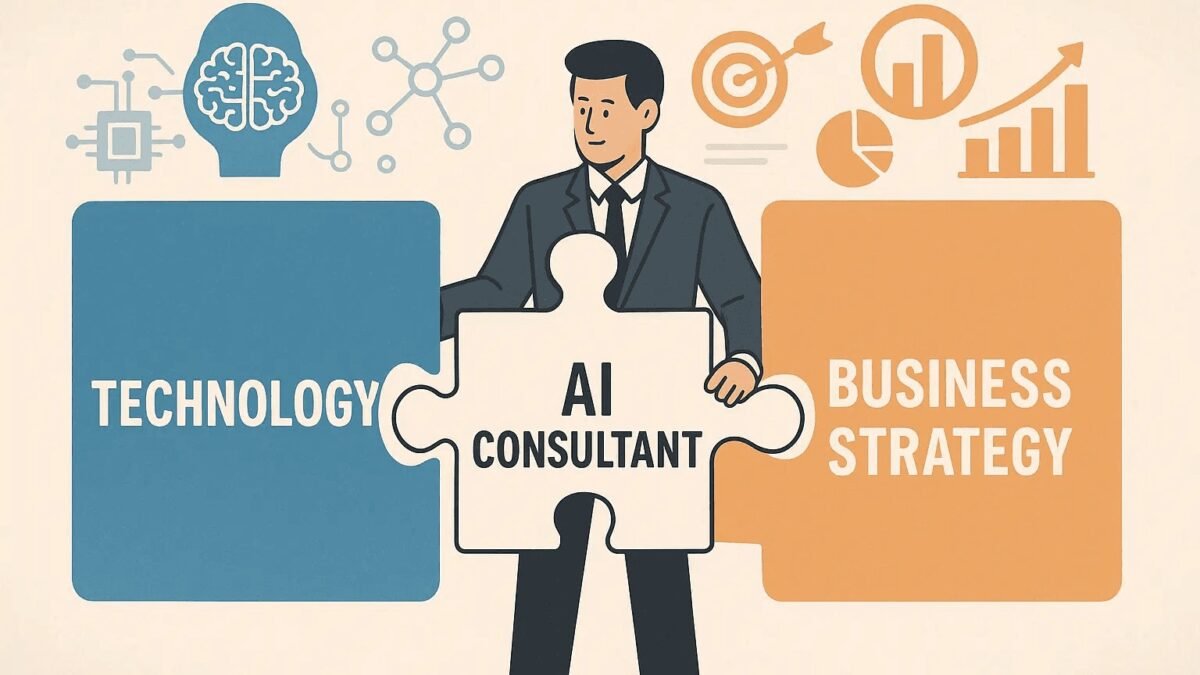
“AI consultant” is the most promising — and most vaguely defined — opportunity in the current market. Businesses know they need AI, don’t know where to start, and will pay well for trusted guidance. How to become an AI consultant for businesses? Not by collecting certificates, but by building a specific stack: enough technical fluency to be credible, enough business sense to be useful, and the positioning to be found. Here’s the full roadmap.
How to become an AI consultant for businesses: What Actually Works
Technical fluency (not PhD-level)
You need to understand AI deeply enough to advise — not to build models. Learn: how LLMs actually work (capabilities, limits, hallucination, context windows), the tool landscape (major models, their strengths, pricing), RAG fundamentals (how business-data AI works), automation platforms (Zapier, Make, n8n), and AI agent concepts (see the agentic enterprise). How: build 5–10 real projects — automations, chatbots, RAG prototypes. Building teaches what courses can’t: what breaks, what costs, what’s actually hard.
Business fluency (the differentiator)
Technical people who can’t talk business fail at consulting. Learn: how businesses measure ROI, common operational pain points by industry, change management basics, and how decisions get made (hint: it’s politics as much as logic). How: study AI ROI measurement, read business case studies, and — critically — talk to business owners about their problems before proposing solutions.
Phase 2: Pick Your Consulting Niche (Month 2–4)
“AI consultant for everyone” = “AI consultant for no one.” By industry: “AI consultant for dental practices / law firms / e-commerce brands” — industry expertise compounds and referrals flow within verticals. By function: “AI for customer service,” “AI for marketing operations,” “AI for sales teams” — functional depth across industries. By outcome: “I help businesses cut support costs 40% with AI” — outcome positioning commands premium pricing.
Choose based on: where you have existing credibility (ex-industry insiders win), where demand is visible (businesses actively asking), and where you can build repeatable offerings (productized consulting scales; bespoke doesn’t).
Phase 3: Build Proof (Months 3–6)
Do free/cheap diagnostic work: “AI opportunity audits” — 2-hour assessments identifying a business’s top 3 AI opportunities with ROI estimates. Low cost to you, high perceived value, natural lead-in to implementation projects. Document everything: every audit, every implementation → case study with numbers. Teach publicly: “5 AI wins for [niche]” content — positions you as the obvious expert and generates inbound. Build 2–3 productized offerings: e.g., “AI Opportunity Audit ($1,500),” “Support Automation Build ($8,000),” “AI Transformation Retainer ($3,000/month).” Productized = sellable without custom proposals every time.
Phase 4: Land Clients and Scale (Month 6+)
Client acquisition: the audit is the wedge — low-commitment, high-value, naturally leading to bigger engagements. Plus partnerships (agencies, IT providers), niche content, and warm network. The full playbook: finding AI service clients and selling AI workflows (consulting’s close cousin).
Pricing: audits $1,000–$3,000; implementation projects $5,000–$50,000+; retainers $2,000–$10,000/month. Price on business value, not hours — an automation saving $200k/year justifies $30k pricing easily. Scaling: productize further, build a small delivery team (you sell and strategize; others implement), develop IP (frameworks, assessments, training programs) that scales beyond your hours.
What Separates Successful AI Consultants
They lead with business outcomes, not AI capabilities. “I’ll cut your support costs 40%” beats “I’ll implement RAG with Claude.” They’re honest about limits — “AI won’t fix your broken process; let’s fix the process first” builds more trust (and revenue) than hype. They specialize — the generalist AI consultant competes with everyone; the niche specialist owns a market. They build, not just advise — consultants who implement (or partner with implementers) capture 10x the revenue of pure advisors. They keep learning — the landscape shifts quarterly; the consultant’s edge is currency.
Common Consulting Pitfalls (Learn From Others’ Mistakes)
Pitfall 1: Selling technology instead of outcomes. “I’ll implement a RAG pipeline with vector embeddings!” — the client’s eyes glaze. They buy “fewer support tickets” and “faster answers.” Every proposal, every conversation: lead with the business outcome, mention the technology once. Pitfall 2: Overpromising AI capabilities. “AI will automate your entire workflow!” — then it handles 70% and the client feels lied to. Promise 70%, deliver 85% — under-promise, over-deliver, especially with AI’s hype cycle working against credibility.
Pitfall 3: Ignoring change management. The technology works; the people don’t adopt it. AI consulting that ignores training, incentives, and culture fails regardless of technical quality. Budget 30% of every engagement for the human side. Pitfall 4: No niche. The generalist AI consultant competes with every tech-savvy freelancer on earth. The specialist owns a market. Niche down by month 3.
Pitfall 5: Hourly billing. Consulting hours don’t scale; value does. Productize and price on outcomes from the start — even if the first few engagements are small. Pitfall 6: Stopping learning. The AI landscape shifts quarterly; the consultant coasting on 2025 knowledge is obsolete by 2026. Build learning into your weekly routine — it’s not overhead, it’s inventory. The consultants thriving: outcome-led, honest about limits, niched, productized, and relentlessly current. Avoid these six pitfalls and you’re ahead of 90% of people calling themselves AI consultants.
The Takeaway
Become an AI consultant via: technical fluency (build real projects) + business fluency (ROI, pain points, decisions) → niche selection → proof-building (audits, case studies, teaching) → productized offerings → client acquisition through value-first audits. Lead with outcomes, specialize deeply, stay honest about limits, and keep learning. The demand is real; the consultants who capture it will be the ones who combine credibility with usefulness.
Community: Indie Hackers — AI consultants sharing real numbers and playbooks.



