
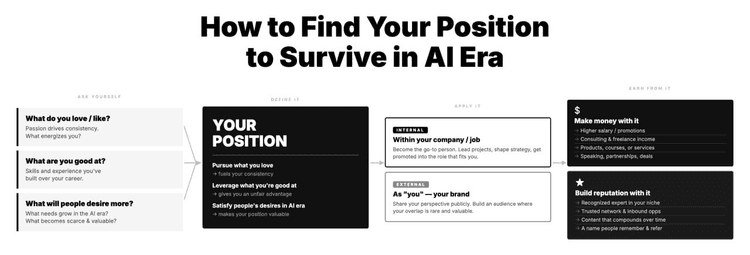
“I use AI tools” is no longer a differentiator — it’s the baseline, like “I use email.” So how to position yourself as an AI-savvy freelancer in a market where everyone claims AI fluency? The answer: don’t position around the tools — position around the outcomes the tools enable, proved with evidence, wrapped in a niche. Here’s the positioning system.
How to position yourself as an AI-savvy freelancer: What Actually Works
Weak: “Freelance writer | AI-powered | ChatGPT expert.” (Everyone. Yawn.) Strong: “I help SaaS companies publish 12 ranking articles/month — strategy, expert review, and distribution included. Typical result: 3x organic traffic in 6 months.” The AI is invisible in the strong version — it’s the how, and clients buy the what. Mention AI in your process description, not your headline: “My AI-accelerated process means faster turnaround without cutting the expert review that makes content rank.”
The formula: [Niche] + [Outcome] + [Proof] + [AI as process advantage]. “I help [dental practices] get [30+ new patient inquiries/month] through [AI-accelerated content + local SEO] — [case study link].”
2. Prove It (Evidence Beats Claims)
Anyone can claim AI savvy; few can prove it. Case studies with numbers: “Client X: from 0 to 15k monthly organic visitors in 6 months using my AI-assisted content system.” Numbers are the proof. Before/after: “This took agencies 3 weeks; my process delivers it in 4 days — here’s the workflow.” Teach publicly: the ultimate positioning — “I wrote the guide on [AI workflow for niche]” makes you the obvious expert. Content about your process attracts clients who want that process.
Certifications help at the margins — see which certifications matter — but proof of results beats proof of coursework every time.
3. Niche Down (AI Makes Niching More Valuable)
Counterintuitive but true: as AI commoditizes general skills, specificity becomes more valuable. “AI-savvy freelancer” is vague; “AI-accelerated content systems for fintech startups” is a business. The niche gives you: deeper expertise (the moat), better AI workflows (reusable within the niche), stronger referrals (niche communities talk), and premium pricing (specialists charge more). Pick the intersection of what you know, what pays, and where AI leverage is highest.
4. Price the Positioning
AI-savvy positioning supports premium pricing — but only if the premium is tied to outcomes. “I charge more because I use AI” fails. “I charge $5k because my system delivers in 2 weeks what takes others 2 months, with case studies proving the results” works. The positioning justifies the price; the proof justifies the positioning. And reassuringly, clients care about results, not tools — so position on results.
5. Keep Evolving (Positioning Isn’t Static)
Today’s “AI-savvy” is tomorrow’s baseline — again. Stay one step ahead: experiment with new tools monthly, share what you learn publicly (which doubles as positioning), and deepen the niche expertise that tools can’t replicate. The freelancers who positioned as “AI experts” in 2023 on tool knowledge alone are already commoditized; the ones who positioned on outcomes in a niche are thriving. For the client-winning tactics behind the positioning: winning clients with AI.
Positioning Mistakes That Backfire
Mistake 1: Leading with tools. “ChatGPT expert | Midjourney pro | AI-powered freelancer” — tools change quarterly; tool-based positioning expires. Worse, it signals you think the tool is the value. Lead with outcomes; mention tools in the process section. Mistake 2: Claiming expertise you can’t prove. “AI consultant” with no case studies, no projects, no public work — the market sees through it instantly, and one bad engagement destroys the positioning permanently. Build proof before claiming the title.
Mistake 3: Competing on “more AI.” “I use 47 AI tools!” — clients don’t care, and it signals button-pushing over judgment. One strong workflow beats a tool collection. Mistake 4: Hiding AI use while marketing AI-savviness. The contradiction confuses clients — are you AI-forward or not? Pick confident transparency; it outperforms both hiding and hype. Mistake 5: Static positioning. “AI-savvy” in 2026 means something different than 2024. Review your positioning quarterly: does it still differentiate? Does the proof still impress? Positioning is a living asset — maintain it.
Mistake 6: No niche. The un-niched “AI-savvy freelancer” competes with everyone. The niched one competes with few. Every positioning element in this guide works better with a niche attached. If you take one corrective action from this section, make it that.
This weekend: rewrite your headline using the formula — [Niche] + [Outcome] + [Proof]. Delete every tool name from it. Move the AI mention to your process section, framed as methodology. Then ask: does this position me on outcomes a client would pay a premium for? If yes, you’re positioned. If it still reads like everyone else’s profile, niche down one more level. Specificity is the entire game.
The Takeaway
Position as an AI-savvy freelancer with: outcome-led messaging (not tool-led), proof via case studies with numbers, a specific niche where AI leverage compounds, premium pricing tied to results, and continuous evolution. You’re not selling AI — you’re selling what AI lets you deliver: faster, better, proven outcomes for a specific kind of client.
Profile inspiration: Contra — see how top freelancers position visually.



