
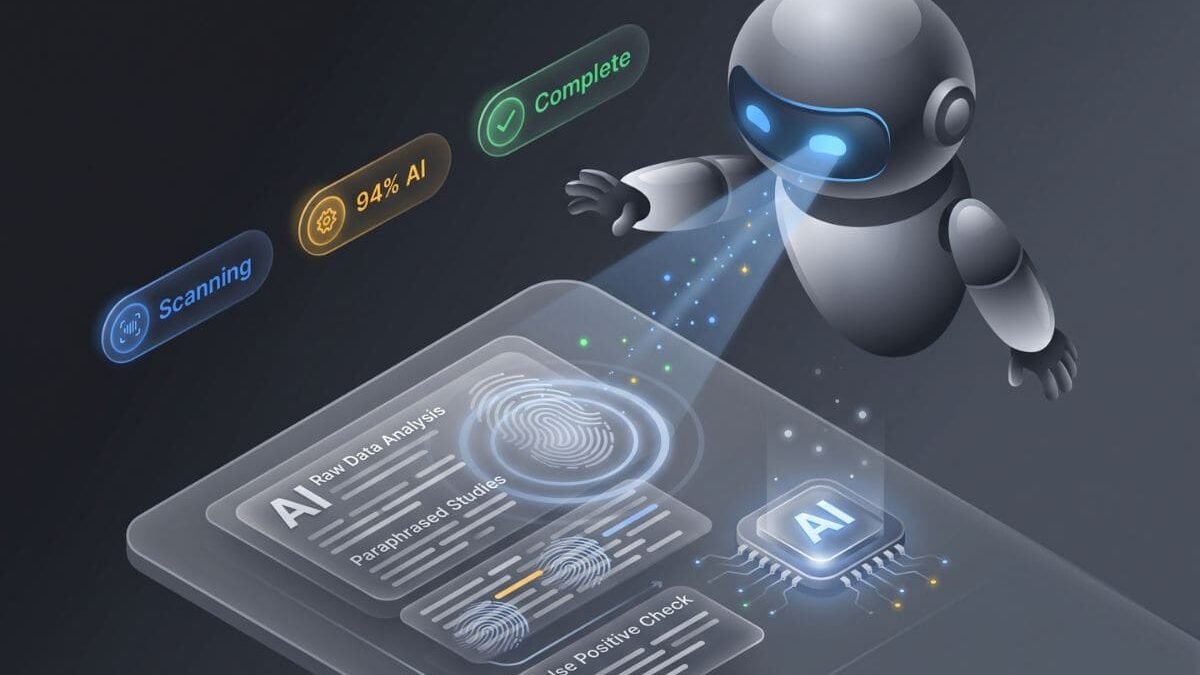
What is the best AI detector in 2026? It’s the question behind a thousand academic integrity hearings, hiring decisions, and editorial arguments. I’ve tested the major detectors extensively — and I need to be upfront: this is a buyer’s guide to an imperfect product category. No detector is fully reliable. But if you need one, some are clearly better than others. Here’s the tested ranking.
The Short Answer
GPTZero and Originality.ai are the most reliable AI detectors available in 2026, scoring roughly 85-90% accuracy on unedited AI text. Turnitin is the best integrated option for academic settings. Everything else is a meaningful step down. And no detector — including these — should be the sole basis for accusing someone of AI use.
How Detectors Work (The 30-Second Version)
AI detectors analyze statistical patterns in text — things like perplexity (how “surprising” word choices are) and burstiness (variation in sentence structure). AI-generated text tends to be more statistically predictable than human writing. The detector scores how “AI-like” these patterns are.
This is why they’re fundamentally limited: good human writing can be statistically predictable, and edited AI text can be statistically human. The signal is real but noisy.
Detailed Ranking
1. GPTZero — Best Free/Accessible Detector
Strongest overall performance in my tests, generous free tier, clean interface, and transparent about limitations (which I respect). Best choice for educators and individuals who need occasional checks.
2. Originality.ai — Best for Publishers
Built for content teams and publishers. Slightly better on some model outputs, with features for workflow integration — team dashboards, API access, plagiarism + AI detection combined. The subscription is worth it if detection is a regular part of your process.
3. Turnitin — Best for Academia
Not the most accurate in absolute terms, but it’s where academic work already flows. For institutions, the integration advantage outweighs small accuracy differences. Students: know that your school likely uses this.
Honorable Mentions
Several others (Copyleaks, Winston AI, Sapling) are competent but didn’t beat the top three in my testing. Free browser-extension detectors are convenient but consistently less accurate — fine for curiosity, not for decisions.
Accuracy Reality Check
- Raw AI text: top detectors catch 85-90%. Good, not perfect.
- Lightly edited AI text: drops to 60-70%. Five minutes of human editing fools most detectors.
- Heavily rewritten: near chance. Undetectable in practice.
- False positives: 5-8% overall, but much higher for non-native English writers. This is the scandal of the industry.
Full methodology and numbers: most accurate AI detector tested.
Can They Tell Which AI Wrote It?
Some detectors attempt model attribution (ChatGPT vs Claude vs Gemini). Accuracy here is poor — 60-70% at best. Interesting for research, useless for decisions. Details: can detectors tell Claude from ChatGPT.
If You’re Falsely Accused
This happens, and it’s awful. Your defense:
- Show your process — drafts, notes, revision history, timestamps
- Point to the research on false positives, especially for ESL writers
- Request holistic review — the detector score is one signal, not a verdict
- Offer to write or explain in person — genuine understanding is hard to fake
The Other Side: Humanizers
Yes, “AI humanizer” tools exist that rewrite AI text to evade detection. They work, to a degree — which is exactly why detectors can’t be trusted as arbiters. Our free humanizer guide covers them, with the ethical caveats they deserve.
What Is the Best AI Detector for Content Agencies?
Agencies face a specific version of the detection problem: clients asking “prove this is human-written.” The honest answer agencies should give: no detector can prove that. What you can provide is process evidence — drafts, revision history, briefs, edit trails. Process transparency beats detection scores.
If you use freelancers, the productive approach is contractual, not technological: clear AI-use policies in agreements, disclosure requirements, and quality standards that make AI-only output fail review. A freelancer delivering genuinely good work with AI assistance is fine; one delivering generic AI output will fail a proper editorial review regardless of detectors.
Educate clients: the question isn’t “was AI involved” but “is this good, accurate, and original?” Judge the work, not the workflow. For background on why detection is unreliable, the documented limitations of AI detection in ChatGPT’s coverage are instructive.
Contract language that works: define acceptable AI use explicitly (research, outlining, grammar) and prohibited use (submitting unedited AI text as original), require disclosure of AI assistance, and tie payment to editorial standards rather than detection scores. Clear contracts prevent more disputes than any detector.
The Bottom Line
What is the best AI detector? GPTZero for most people, Originality.ai for publishers, Turnitin for schools. They’re the best available — and still not good enough to trust alone. Use detectors as a starting signal, never a final judgment. And if you’re designing systems (classrooms, hiring, publishing), build processes that don’t depend on detection at all. That’s the only winning move.



