
“What language should I learn for AI?” It’s the most common career question I get, and the answer has shifted as the field matured. Which programming language is best for AI careers in 2026? I’ve looked at actual job listings, talked to hiring managers, and tracked where the field is going. Here’s the data-driven answer — not just “learn Python” (though that’s part of it), but the full picture.
The Short Answer
Python first, always. It’s the lingua franca of AI — every major framework, every research paper’s code, every job listing. If you learn one language for AI, it’s Python. But “Python and…” is the real answer, because different AI career paths need different second languages.
By AI Career Path
ML Engineer / Applied AI
Python (PyTorch, TensorFlow, scikit-learn, Hugging Face). This is the core. Add SQL (data is everything) and enough bash/cloud to deploy. The AI engineer salary data shows why this path pays.
AI Research
Python (PyTorch dominant in research). Add C++/CUDA if you go deep into systems/optimization — the researchers who understand what’s under PyTorch’s hood are rare and valuable. Math (linear algebra, probability, calculus) matters more than a second language here.
LLM Application Developer
Python (LangChain, APIs) or TypeScript (if building web-integrated AI products). This is the fastest-growing category — building products on AI models rather than training them. Our agent frameworks guide shows the tooling.
MLOps / AI Infrastructure
Python plus Go (infrastructure tooling) and serious cloud/DevOps skills (Kubernetes, Docker, CI/CD). The unsexy backbone the whole field runs on — and chronically underhired.
Data Scientist (AI-adjacent)
Python (pandas, scikit-learn) and SQL (non-negotiable). R still has niches (academia, biostatistics) but Python won the industry.
The Language Ranking for AI Careers
- Python — mandatory. No exceptions, no debate.
- SQL — the most underrated AI career skill. All AI runs on data; data lives in databases.
- TypeScript/JavaScript — for AI product development and web integration.
- C++ — for deep systems/optimization work. High value, high difficulty.
- Go / Rust — for infrastructure and performance-critical AI systems.
- bash / Shell — not a “language” people list, but daily reality.
What Matters More Than Language
Hiring managers consistently tell me language is table stakes. What differentiates:
- Math foundations: linear algebra, probability, statistics, calculus. The engineers who understand why models work outlast framework churn.
- Shipped projects: a GitHub with working AI projects beats certificates. Build things.
- Domain knowledge: AI + healthcare, AI + finance, AI + [your field] — the intersection is where careers are.
- System design: can you build AI that works in production, not just in notebooks?
Full skill breakdown: skills for AI jobs. Market overview: jobs using AI most.
Learning Path (12 Months)
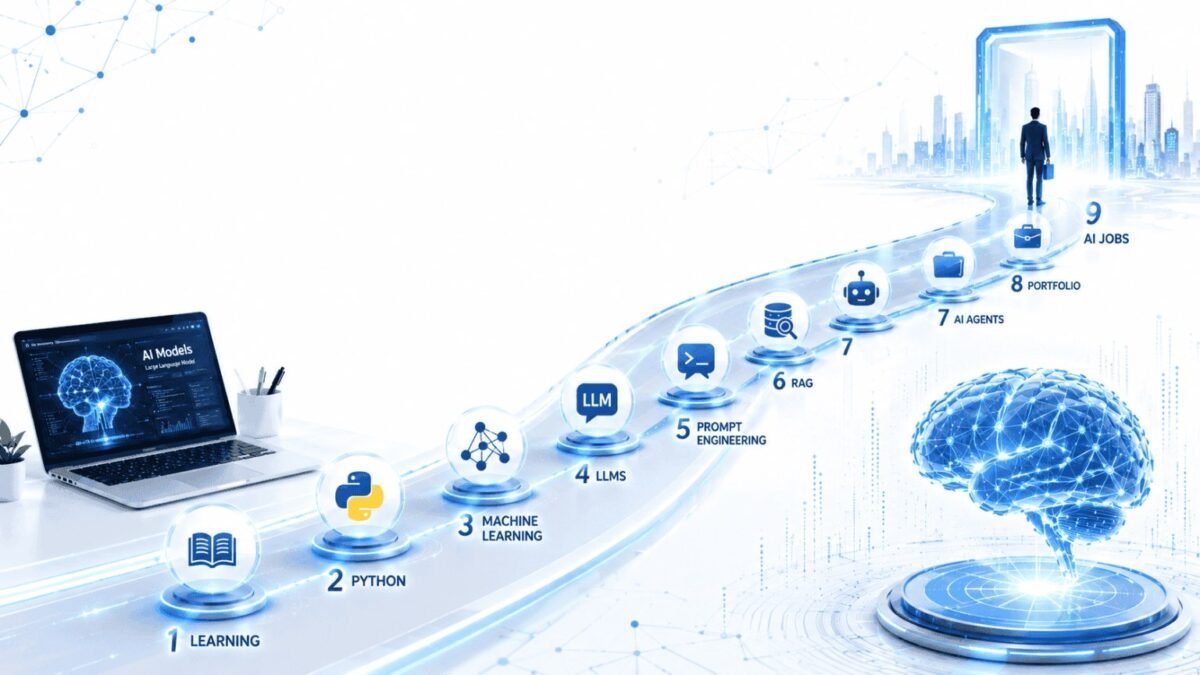
- Months 1-3: Python fundamentals + SQL. Build small projects.
- Months 4-6: ML basics (scikit-learn), math foundations alongside.
- Months 7-9: Deep learning (PyTorch), Hugging Face ecosystem. Build and deploy a real project.
- Months 10-12: Specialize (LLM apps, MLOps, research) + interview prep + portfolio polish.
Which Programming Language Is Best for AI Careers in 2026 and Beyond?
The honest answer: Python first, then depth in one more. Python dominates AI/ML work — frameworks, tutorials, jobs, community. It is the default language of the field and will remain so. Learn it well.
Your second language depends on direction: TypeScript/JavaScript for AI product development, Rust or C++ for performance-critical ML systems, SQL for data-heavy roles (non-negotiable regardless — every AI career touches data). Pick based on the jobs you actually want, not hype.
Beyond languages: the durable skills are math fundamentals (linear algebra, probability), ML concepts, and the ability to evaluate AI systems critically. Languages get you interviews; fundamentals get you careers. For how AI models themselves evolved, Claude’s documented history is instructive.
Math fundamentals outlast language trends: linear algebra and probability underpin everything in AI, regardless of which language is fashionable. An hour spent on fundamentals pays more career dividends than an hour on syntax. Languages are tools; mathematical thinking is the craft.
Build one substantial project per language you claim: employers trust portfolios over resumes. A working project demonstrates more than a certificate — and the building process teaches what tutorials cannot.
Teach what you learn: explaining concepts to others reveals your own gaps. Blogging your learning journey builds both skill and visibility.
Stay curious about new languages and tools, but go deep on fundamentals: trends change, but core computer science endures.
One last thought: the best AI career investment is learning to evaluate AI systems critically. Builders who can tell good output from bad will always be in demand.
The Bottom Line
Which programming language is best for AI careers? Python — it’s not close, and it’s not changing. Add SQL immediately, then specialize based on your path (TypeScript for products, C++ for systems, Go for infrastructure). But remember: language gets you interviews; math, shipped projects, and domain knowledge get you hired. Learn Python deeply, build relentlessly, and specialize deliberately. The AI field rewards the prepared.



