
Here’s the uncomfortable truth about AI and SEO content: Google doesn’t penalize AI-assisted content — it penalizes bad content, and most AI-generated content is bad because the workflow is bad. How to write SEO articles with AI assistance that actually rank? It’s a specific workflow where AI does the heavy lifting and humans supply the ranking factors AI can’t fake: expertise, experience, and original insight. Here’s the method.
How to write SEO articles with AI assistance: What Actually Works
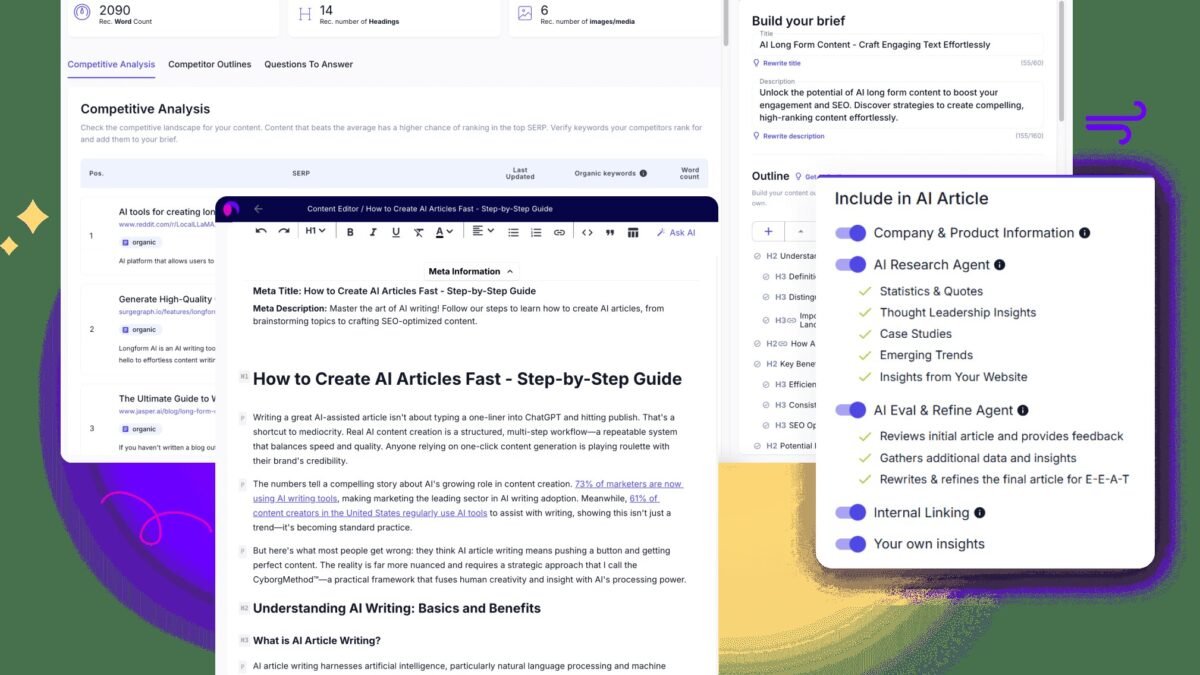
Keyword and intent analysis: start with AI keyword research — but the critical step is human: what does the searcher actually want? AI can suggest; you decide. SERP analysis: “Analyze the top 5 results for [keyword]: what subtopics do they cover, what questions do they answer, where are the gaps?” The gaps are your opportunity — covering what competitors miss is how new pages win. Brief creation: build a detailed brief — target keyword, search intent, required subtopics, questions to answer (from People Also Ask), word count target based on top performers, internal linking opportunities. The brief is the most important document in AI-assisted SEO writing; garbage brief, garbage article.
Phase 2: Drafting (AI Does the Heavy Lifting)
Feed the AI the brief and have it draft section by section — not the whole article at once (quality degrades with length). “Write the section on [subtopic] for [audience]: cover [points], ~300 words, conversational tone, include a concrete example.” Generate the boring parts freely: definitions, background context, FAQ answers — AI handles these well. Mark the expertise gaps: as you review the draft, flag every section that needs your input — marked with [EXPERTISE NEEDED] as you go.
Phase 3: The Human Expertise Injection (This Is What Ranks)
This phase is non-negotiable and it’s what separates ranking content from content-farm output:
- Add original experience: “In our testing…”, “Our clients typically see…”, “I’ve found that…” — first-hand experience is Google’s E-E-A-T gold.
- Add original data: even small surveys, case numbers, or before/after metrics. Original data earns links; regurgitated advice doesn’t.
- Add specific examples: replace every generic statement with a concrete one. “Businesses save time” → “our client’s invoicing dropped from 6 hours to 40 minutes weekly.”
- Add genuine opinion: take a stance. “Most guides recommend X; we disagree because…” — opinionated content gets read, shared, and linked.
- Verify everything: every statistic, every claim, every “fact” the AI stated. Hallucinated statistics in published content destroy credibility.
Phase 4: SEO Optimization
On-page: title tag (keyword near front, under 60 chars), meta description (compelling, under 160), H1/H2 structure with keyword in one H2, natural keyword distribution (write for humans; check density after). Internal linking: 2–4 links to relevant existing content with descriptive anchors. External linking: 1–3 links to authoritative sources. Readability: short paragraphs, scannable structure, lists where natural. Final human read: read the entire article aloud (or have AI read it to you). Awkward phrasing, repetition, and tone shifts reveal themselves in audio.
What Google Actually Wants (2026 Reality)
Google’s helpful content systems reward satisfying search intent with demonstrable expertise. AI can produce the structure; only you can supply the E-E-A-T. The sites winning with AI-assisted content share traits: heavy human editing, original insights in every piece, real author bylines with credentials, and content they’d be proud to show customers. The sites losing: publishing AI drafts with light edits, at volume, with no differentiation. Same tool, opposite outcomes — the workflow is the ranking factor. Pair with technical SEO health and the broader digital marketing playbook.
Scaling Without Becoming a Content Farm
The temptation with AI-assisted writing is volume — 100 articles a month! Resist it, or at least channel it wisely. The quality-scaled approach: publish fewer pieces than AI makes possible, but make each one genuinely excellent. 4 outstanding articles/month beats 40 mediocre ones — for rankings, for links, for brand, for conversions. Every metric that matters rewards quality over quantity.
The content moat: as AI makes generic content worthless, the moat is everything AI can’t do — your proprietary data, your contrarian opinions, your customer stories, your original research. Build processes that systematically capture these: quarterly customer surveys, annual industry data, case study pipelines. Feed the moat into every article.
Editorial standards for AI-assisted content: every piece gets human expert review (not just proofreading), every claim gets verified, every article must contain something original (a testable standard — “what’s new here?”). The byline question: put real author names with real credentials on AI-assisted content. Accountability improves quality, and E-E-A-T rewards it. Update, don’t just publish: the highest-ROI SEO activity is often refreshing existing winners with new data and insights — AI accelerates updates beautifully. The long game: sites that thrive in the AI era aren’t the ones publishing most — they’re the ones publishing what only they could publish, at a pace AI makes sustainable. Be that site.
The Takeaway
Rank-worthy AI-assisted SEO articles follow: human-led briefs from SERP gap analysis, section-by-section AI drafting, heavy human expertise injection (experience, data, examples, opinions), and thorough on-page optimization. AI supplies speed and structure; you supply the E-E-A-T that actually ranks. Skip the expertise injection and you’re just adding to the content landfill.
Guidelines: Google’s helpful content guidance — the actual rules of the game.




1 Comment