
Email marketing still has the highest ROI in digital marketing — $36+ per $1 spent by most estimates. And it’s also one of the most AI-transformable channels: the writing is formulaic enough for AI to draft well, and personal enough that human refinement matters enormously. How to use AI for email marketing copy? Here’s the workflow that lifts opens, clicks, and revenue — without sounding like a robot.
How to use AI for email marketing copy: What Actually Works
Subject lines determine opens; opens determine everything. AI is a subject-line machine: generate in batches — “Write 20 subject lines for [email topic], mixing curiosity, benefit, urgency, and personal angles, all under 50 characters.” Test systematically — pick the 3 most different (not the 3 you like most) and A/B test. Learn your audience’s patterns — after 10 campaigns, feed AI your open rates: “Here are my last 20 subject lines with open rates — what patterns do you see in the winners?” The AI spots what works for your list better than generic best practices.
What to avoid: clickbait that erodes trust, excessive personalization tokens (“{{FIRSTNAME}}, you won’t BELIEVE…”), and subject lines the email doesn’t deliver on. AI will happily generate all three — your judgment filters.
Campaign Drafting (The Core Workflow)
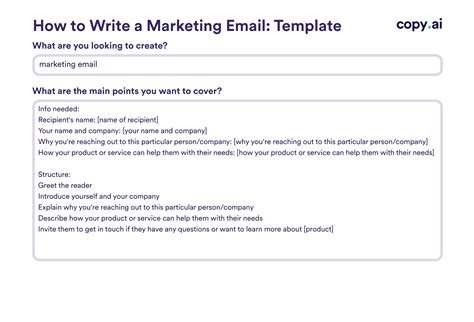
- Brief, don’t prompt-and-pray. “Write a promotional email for [product] to [segment]: goal is [action], key points are [3 bullets], tone is [your brand voice], length ~150 words, CTA is [specific].” Specific briefs get usable drafts; vague prompts get generic mush.
- Generate 3 variants. Different angles — story-led, benefit-led, urgency-led. You’ll usually Frankenstein the best parts together.
- Inject the human elements. Your anecdote, your customer’s quote, the specific detail AI couldn’t know. This is what separates converting emails from competent ones.
- AI-edit for the checklist: “Review this draft for: clear single CTA, mobile-friendly length, spam trigger words, and preview-text optimization.”
Sequences and Automation
Welcome sequences: “Draft a 5-email welcome sequence for new subscribers to [business]: email 1 delivers the lead magnet + sets expectations, 2–4 provide value and build trust, 5 makes a soft offer.” Abandoned cart: 3-email sequence — reminder, objection-handler, urgency — each with a distinct angle. Re-engagement: “Draft a win-back sequence for subscribers inactive 90+ days — acknowledge the silence honestly, offer something genuinely valuable.” Post-purchase: onboarding, usage tips, review requests, upsells — the revenue multiplier most businesses neglect.
For the personalization layer that makes sequences sing, see personalizing marketing emails with AI.
Voice and Brand Consistency
The biggest risk: every email sounding like “AI marketing voice.” Fix it with a voice guide: feed AI 5 of your best past emails — “Analyze my writing voice: tone, sentence patterns, humor, how I open and close. Save this as my voice profile.” Then invoke it: “Draft this campaign in my voice profile.” Review the first few carefully — the profile improves as you correct it. And never send without reading. AI is your copywriter, not your publisher. The 2-minute read-through catches the tone-deaf phrase, the wrong detail, the almost-right-but-off CTA that would have cost you.
This fits the broader digital marketing playbook, and the drafting discipline mirrors AI-assisted SEO writing.
Advanced: Lifecycle Email Strategy With AI
Beyond individual campaigns, AI enables genuine lifecycle marketing — the right message at each customer stage, mostly automated. Map your lifecycle: subscriber → engaged → first purchase → repeat customer → loyalist → at-risk → win-back. For each stage, define the goal (educate? convert? retain?) and the emails needed.
AI builds each stage: “Draft the 3-email series for [stage]: goal is [goal], key messages are [points], tone is [voice].” Then connect the stages with behavioral triggers — purchase → post-purchase series; 60 days inactive → re-engagement; high engagement + no purchase → offer series. The content engine: one monthly “pillar” email (your best thinking) becomes stage-appropriate variants — the same insight adapted for prospects vs. customers vs. loyalists. AI does the adaptation; you provide the insight.
Testing at the lifecycle level: most businesses A/B test subject lines (tactical). Few test lifecycle structure (strategic): “Does a 5-email welcome series outperform 3? Does post-purchase education reduce returns?” AI makes generating test variants cheap — use that leverage on strategic questions, not just tactical ones. The measurement: revenue per subscriber by lifecycle stage, tracked monthly. When a stage underperforms, AI helps diagnose (“analyze these emails’ engagement vs. the stage goal — where’s the disconnect?”) and rebuild. Lifecycle email is where AI’s production speed meets marketing’s strategic depth — and it’s the highest-ROI email work most businesses aren’t doing.
The Takeaway
Use AI for email copy as: subject-line generator (batch + test), campaign drafter (brief specifically, generate variants, inject human elements), sequence builder (welcome, cart, win-back, post-purchase), and voice-consistent writer (via a trained voice profile). Always read before sending. The result: more emails, better emails, less time — the email marketer’s trifecta.
Benchmarks: Mailchimp’s email benchmarks — know your baseline before optimizing.



