
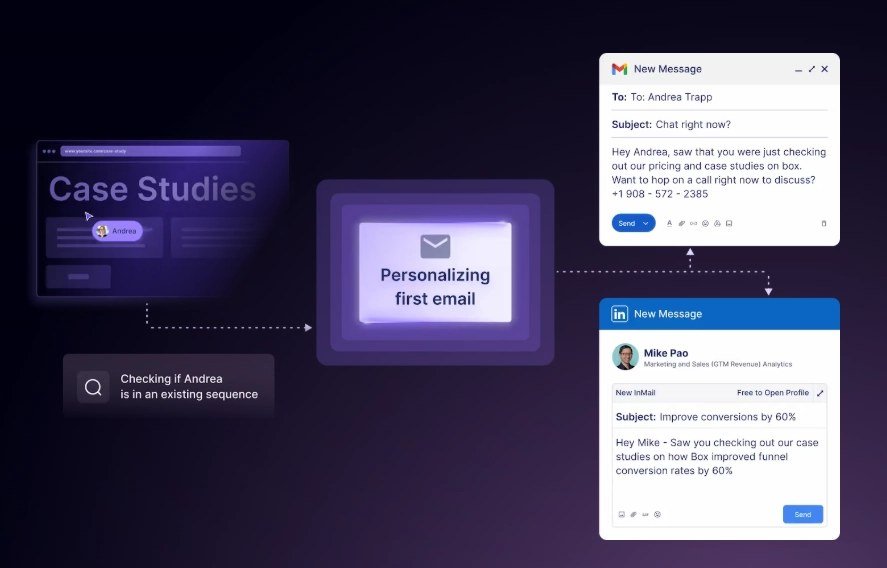
“Hi {FIRSTNAME}” isn’t personalization — it’s mail merge with better branding. Real personalization means the email feels like it was written for this person, considering what they’ve done, what they need, and where they are. How to personalize marketing emails with AI? It’s the difference between inserting a name and adapting the entire message — and AI finally makes the latter scalable. Here’s how.
How to personalize marketing emails with AI: What Actually Works
Define meaningful segments: not just demographics — behavior and context. New vs. returning customers, browsers vs. buyers, high-engagement vs. dormant, industry, company size, purchase history. AI-assisted segment messaging: “Rewrite this campaign email for [segment]: emphasize [their concerns], use [their language], CTA is [segment-appropriate action].” One campaign becomes five resonant versions in minutes. Subject line per segment: what intrigues new prospects differs from what re-engages dormant ones — generate accordingly.
This alone — proper segmentation with AI-adapted messaging — typically lifts engagement 20–50% over one-size-fits-all. Most businesses stop here and do fine. But there’s more.
Level 2: Behavioral Personalization
Trigger-based emails: browse abandonment (“you looked at X — here’s what customers ask about it”), post-purchase sequences tailored to what they bought, milestone emails (anniversary, usage thresholds), re-engagement with their last interest. AI drafts each trigger’s content; your data provides the triggers. Dynamic content blocks: “For customers who bought product A, insert the accessories section; for service clients, insert the case study section” — AI generates all variants from one brief. Send-time optimization: AI analyzes when each subscriber engages and schedules accordingly — the same email, delivered at their 9 AM.
Level 3: True 1:1 Personalization (The Frontier)
AI-drafted individual emails: for high-value prospects, “draft a check-in email for [contact]: reference their [recent company news], connect it to [how we help], suggest [specific next step].” Reviewed by humans, sent individually — 50 of these outperform 5,000 generic blasts for B2B. Conversation-aware follow-ups: “Based on this email thread [paste], draft a follow-up that addresses their unstated concern about [X].” Account-based personalization: entire email experiences tailored per target account — their industry challenges, their competitors, their initiatives.
The Guardrails (Personalization Can Creep People Out)
The uncanny valley: “I saw you visited our pricing page 3 times on Tuesday” feels like surveillance, not service. Use behavioral data to be relevant, not to demonstrate you’re watching. Privacy compliance: GDPR, CCPA, and evolving regulations — know what data you can use and honor opt-outs meticulously. Data accuracy: personalization with wrong data (“enjoy your new baby!” to someone childless) is worse than none. Verify data quality before scaling. Frequency respect: personalization doesn’t justify more emails — relevance should reduce the need for volume. And the human check remains: read before sending, always.
This is the precision layer on top of AI lead generation and within the digital marketing system.
Case Study: The Segmentation That Doubled Revenue Per Email
A mid-size B2B software company was sending one monthly newsletter to 40,000 subscribers: 18% open rate, 1.2% click rate, steady but flat. They implemented AI-assisted segmentation in stages. Stage 1 (month 1–2): split into 4 behavioral segments (trial users, active customers, dormant accounts, newsletter-only) with AI-adapted messaging per segment. Result: opens to 24%, clicks to 2.1%. Same content effort, ~40% more engagement — just from relevance.
Stage 2 (month 3–4): added behavioral triggers — trial expiry sequences, feature-adoption nudges based on usage data, dormant re-engagement with personalized “here’s what you missed.” AI drafted all trigger content from briefs. Result: trial-to-paid conversion up 15%, dormant reactivation up 30%.
Stage 3 (month 5–6): 1:1 AI-drafted outreach for top-200 accounts — researched, personalized, human-reviewed. Result: 3 enterprise deals attributed directly ($180k pipeline).
Total investment: ~$500/month in tools + 10 hours/week of one marketer’s time. Total return: email-attributed revenue doubled in 6 months. The lessons: start with segmentation (biggest bang for effort), add triggers second (automation leverage), reserve 1:1 for high-value targets (where the effort justifies). And throughout: the AI drafted, the human reviewed, the data guided. Personalization at scale isn’t a tool purchase — it’s a staged capability build. Start where this company did: four segments, one month, measured.
Your 30-day challenge: segment your list into just 3 behavioral groups and adapt your next campaign’s messaging per segment with AI help. Measure opens and clicks per segment against your last one-size-fits-all send. That single test — one campaign, three versions, measured — will convince you more than any case study. Most businesses see the lift immediately and never go back to blast emails.
The Takeaway
Personalize emails with AI in three levels: segment-adapted messaging (start here, big gains), behavioral triggers and dynamic content (the automation layer), and true 1:1 drafting for high-value contacts (the frontier). Stay relevant without being creepy, comply with privacy law, verify your data — and watch engagement climb while unsubscribes fall.
Privacy baseline: GDPR.eu — know the rules before personalizing.



