
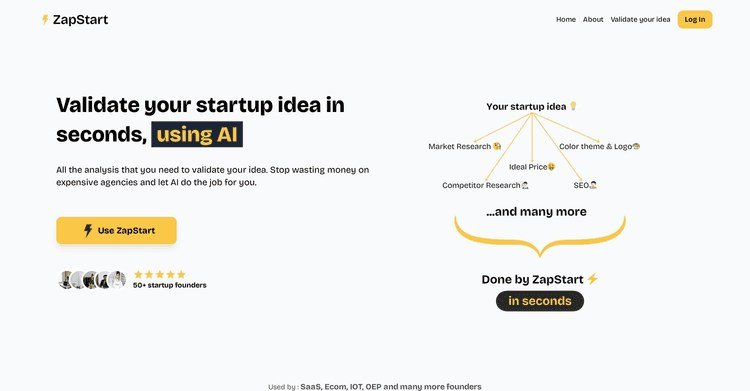
Every founder has been here: an idea that feels brilliant at 2 AM, and the gnawing question at 9 AM — “is this actually a business, or just a fun thought?” Can AI help validate a startup idea? Yes — substantially. AI compresses weeks of preliminary validation into days. But it can’t do the one validation that matters most (talking to real customers), so let’s be precise about where AI helps and where only humans can.
Can AI help validate a startup idea? The Honest Answer
Market research in hours, not weeks
“Analyze the market for [idea]: estimate TAM/SAM/SOM, identify the key segments, describe the buying triggers, and list the top 5 trends affecting this space.” AI synthesizes public market data, reports, and patterns fast. Caveat: treat AI market sizing as directional, not precise — it’s great for “is this a $10M or $10B market?” and unreliable for “is it $412M?” Cross-check the big numbers against real reports.
Competitor analysis
“List all competitors — direct and indirect — for [idea], including their pricing, positioning, funding, and apparent weaknesses. Who’s winning and why?” AI is excellent at mapping competitive landscapes from public data. Follow up: “What gaps exist that a new entrant could exploit?” The gaps are your opportunity thesis.
Business model stress-testing
“Here are my assumptions [list]. Attack them — what’s the weakest assumption, and what evidence would prove or disprove it?” AI as devil’s advocate is brutally useful. It’ll find the flaw in your pricing logic, the chicken-and-egg problem in your marketplace, the CAC assumption that’s fantasy. This is the highest-value AI validation exercise — a harsh critique before you spend a dollar.
Customer persona development
“Build detailed buyer personas for [idea]: demographics, psychographics, buying process, objections, where they hang out online.” These personas then guide the human validation — you know who to talk to and what to ask.
What AI Cannot Validate (The Critical Limit)
Willingness to pay. AI can estimate, model, and project — but only a human with a credit card validates demand. No amount of AI analysis substitutes for 20 customer conversations and (better) 3 pre-sales. Your unfair advantage. AI doesn’t know your network, your domain expertise, your distribution edge. Validation must account for your specific ability to execute, not a generic founder’s. Timing and luck. Markets have windows; AI analyzes the present better than the inflection. Your judgment on timing is irreplaceable.
The honest framework: AI validates the idea’s logic; humans validate the market’s desire. Do the AI work first (it’s fast and cheap), then spend your expensive human time only on ideas that survive it.
The 2-Week AI Validation Sprint
Days 1–2: market sizing and trend analysis. Kill or continue. Days 3–4: competitor mapping and gap analysis. Days 5–6: assumption stress-testing — the devil’s advocate session. Rewrite the idea based on what breaks. Days 7–8: business model canvas via AI collaboration — revenue streams, cost structure, channels, all pressure-tested. Days 9–10: persona development and interview planning — “draft 15 customer discovery questions that avoid leading the witness.” Days 11–14: human validation — 15–20 customer conversations using the AI-planned questions. Decision: proceed, pivot, or kill — with evidence, not vibes.
Ideas that survive this sprint deserve real resources. Ideas that die here cost you two weeks instead of two years. That’s the actual value proposition — fast, cheap failure for bad ideas and evidence-backed confidence for good ones. For the business math once validated, see measuring AI ROI; for finding early customers, AI lead generation.
AI Validation Mistakes That Kill Good Ideas (And Save Bad Ones)
Mistake 1: Treating AI market sizing as truth. AI-estimated TAMs feel precise and are often wrong by orders of magnitude. Use them for order-of-magnitude gut checks only, then validate with real data: industry reports, proxy metrics, and (best) customer conversations. Mistake 2: Validating the idea instead of the problem. “Is my solution good?” is the wrong question; “is the problem painful, frequent, and expensive?” is the right one. AI can help you interrogate the problem — “what evidence exists that [problem] costs [audience] real money?” — which is far more predictive than solution feedback.
Mistake 3: Confirmation bias via leading prompts. “Tell me why my idea will succeed” gets cheerleading. Always prompt adversarially: “steelman the case against this idea.” Mistake 4: Skipping the human step because AI was encouraging. This is the fatal one — AI analysis feels like validation, but only customers validate. The 2-week sprint structure exists precisely to force the human conversations. Mistake 5: Analysis paralysis. Two weeks of AI validation, then decide. Founders who validate for six months aren’t validating — they’re procrastinating. At some point the remaining uncertainty can only be resolved by building and selling. AI gets you to that point faster; don’t let it become the delay itself.
The Takeaway
AI validates startup ideas fast: market research, competitor mapping, assumption stress-testing, and persona development in days. But willingness to pay only validates through human customers — run the 2-week AI sprint, then do the 20 conversations. Kill fast, validate honestly, and build only what survives both.
Methodology: Y Combinator’s startup library — the human-validation gold standard.



