
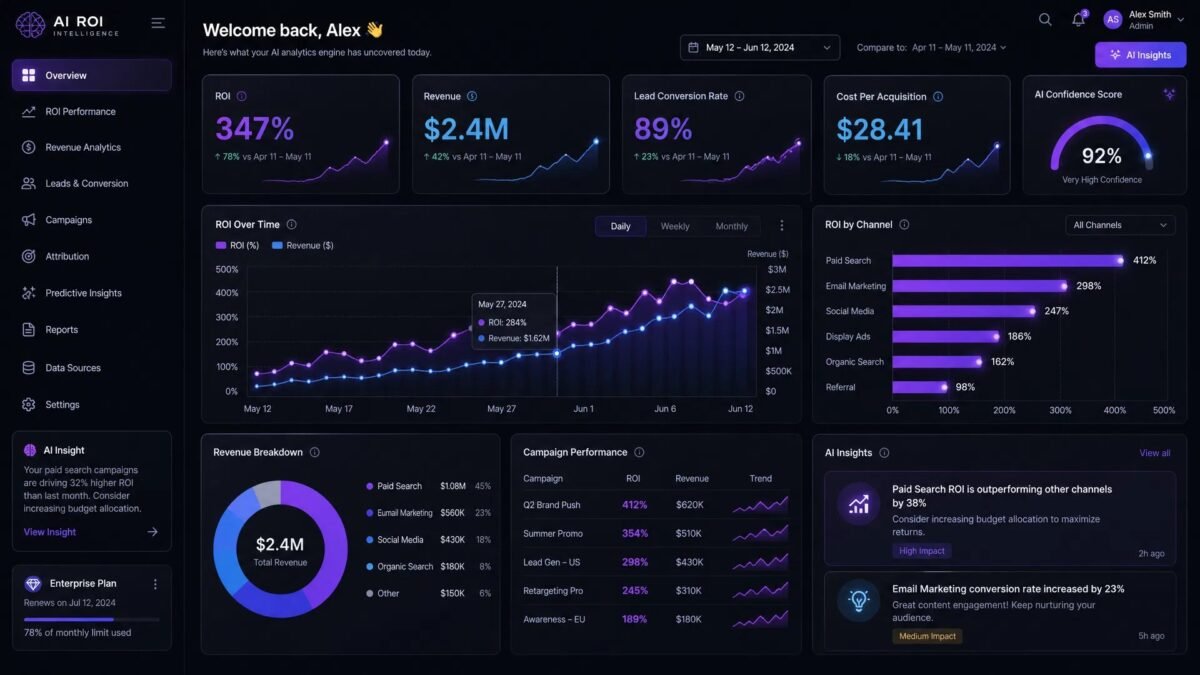
“We’re investing in AI” — great, but is it paying off? Most businesses adopting AI have no idea, running on vibes and vendor promises. How to measure AI ROI for business isn’t just finance hygiene; it’s how you decide what to scale, what to kill, and what to try next. Here’s the measurement framework that actually works, without a data science team.
How to measure ai roi for business: What Actually Works
1. Time savings (easiest to measure)
Formula: (hours saved per week) × (fully-loaded hourly cost) × 52 = annual value. Example: AI-assisted content creation saves your marketer 8 hours/week at $50/hour loaded = $20,800/year. How to measure: time the task before and after, over 2–4 weeks. Be honest — measure real workflows, not demos. Subtract the time spent managing the AI (prompting, reviewing, fixing) — net savings is what counts.
2. Cost reduction (direct savings)
Formula: (old cost − new cost) for the same output. Examples: support tickets deflected by AI chat (tickets × cost-per-ticket), agency spend replaced by in-house AI-assisted work, software consolidated. Caution: only count avoided costs you’d actually have incurred — “we would have hired someone” counts only if you were actually going to hire.
3. Revenue lift (hardest, most valuable)
Formula: (revenue with AI − baseline revenue) attributable to AI initiatives. Examples: faster lead response → higher conversion (measure conversion rates before/after), AI-personalized emails → higher click rates, AI-assisted sales → bigger pipeline. Attribution discipline: isolate the variable — compare periods, A/B test where possible, and be conservative. Revenue claims need the most rigor because they’re the easiest to inflate.
The Measurement Framework
- Baseline first. Before implementing, measure the current state: time per task, cost per output, conversion rates. No baseline, no ROI — just stories.
- Define success metrics upfront. For each AI initiative: one primary metric, measured how, over what period. Write it down before starting.
- Track total cost. Subscriptions + implementation time + training + ongoing management. The $20/month tool that needs 5 hours/week of babysitting isn’t $20/month.
- Review quarterly. What’s the ROI per initiative? Scale winners, fix or kill losers. AI portfolios need gardening like any investment.
- Include intangibles separately. Employee satisfaction, faster decisions, better customer experience — real but not ROI. Note them; don’t monetize them creatively.
Common ROI Mistakes
Counting gross instead of net (forgetting the management overhead). Attributing everything to AI (revenue was growing anyway). Ignoring the learning curve (month 1 looks bad; measure months 3–6). Measuring vanity metrics (“we generated 10,000 words!” — so what?). Never killing losers — the sunk-cost AI project that nobody uses but everyone pays for. And comparing against perfection instead of against the actual alternative (the AI doesn’t need to be perfect; it needs to beat the status quo).
For the small-business-specific version with concrete numbers, see AI cost analysis for small business — and for what to measure, start with the highest-ROI small business applications.
A Worked Example: Marketing Agency ROI
Let’s run the full framework on a concrete case — a 10-person marketing agency adopting AI for content production. Baseline (before): each content specialist produces 4 blog posts/week, spending ~6 hours per post (research, drafting, editing). 3 specialists = 12 posts/week, 72 hours/week on content.
After AI (month 4, past the learning curve): same specialists produce 6 posts/week each at ~4 hours per post (AI drafts from briefs, humans add expertise and edit). 18 posts/week, 72 hours/week. Time savings calculation: output increased 50% with same hours — equivalent to hiring 1.5 specialists at $60k loaded = $90,000/year in avoided hiring. Costs: $60/month tools × 12 = $720; implementation (40 hours × $75) = $3,000; ongoing management (2 hrs/week × $75 × 52) = $7,800. Total: ~$11,500/year.
ROI: ($90,000 − $11,500) ÷ $11,500 = 683%. Even halving the benefit for conservatism: 290%. Revenue lift (bonus): faster turnaround won 2 additional retainer clients ($4k/month each) attributed to capacity — $96k/year incremental. The honest caveats: quality had to be monitored (one quarter of dipping quality cost a client — factored into the learning), and the first two months showed negative ROI during learning. Measured at month 6+, the investment is unambiguous. Your turn: plug your own numbers into this template. The framework works for any initiative — the discipline is capturing the baseline before you start.
Start measuring today: pick the AI initiative you’re most unsure about and capture its baseline this week — time per task, cost per output, current conversion rate. Write it down somewhere you’ll find it in 90 days. That single act of baselining separates the businesses that know their AI ROI from the ones running on vibes. Future you, deciding what to scale and what to kill, will be grateful.
The Takeaway
Measure AI ROI in three categories — time savings (hours × rate), cost reduction (old minus new), revenue lift (attributed carefully) — against baselines captured before implementation, with total costs included and quarterly reviews. The businesses that measure scale what works; the ones that don’t scale what vendors sold them.
Methodology: McKinsey’s AI research publishes enterprise AI value measurement frameworks.




1 Comment