
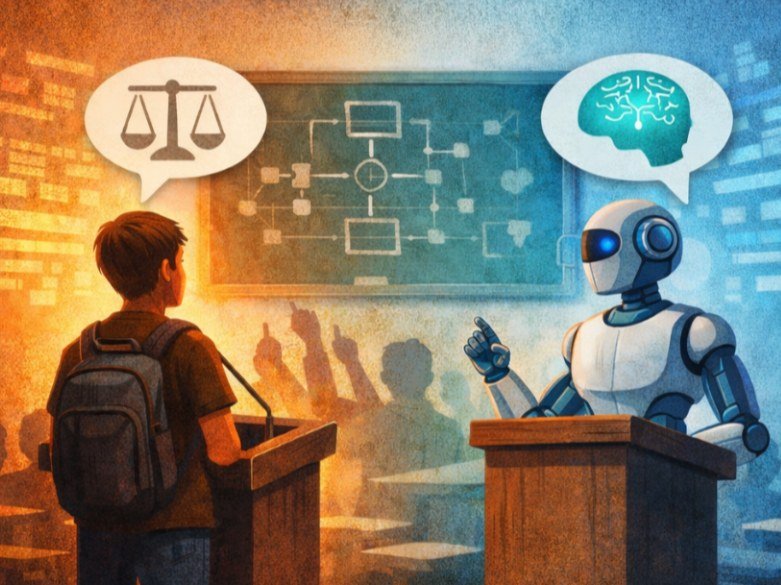
Classroom debates are pedagogical gold — they build critical thinking, evidence use, and civil discourse — but they’re hard to run well. Preparation is heavy, facilitation is delicate, and the loudest voices dominate. Running AI-assisted classroom debates and discussions addresses all three: AI helps students prepare stronger arguments, helps you facilitate more equitably, and turns the aftermath into deeper learning. Here’s the full playbook. This guide covers How to run AI-assisted classroom debates and discussions — clearly, honestly, and without the fluff.
How to run AI-assisted classroom debates and discussions: What Actually Works
Topic selection: “Suggest 10 debate topics for 8th graders on [unit], ranging from accessible to challenging, each with a genuine two-sided tension.” The “genuine tension” instruction matters — bad debate topics have obvious right answers. Student research support: students use AI to find arguments and evidence for their side — with the crucial requirement that they verify every claim against real sources. Teach this as part of the prep: “AI suggested this statistic — find the original source before using it.”
Steel-manning exercise: each side must use AI to build the strongest version of the opposing argument — “What’s the best case against our position?” This single exercise does more for intellectual humility than a semester of lectures. Role cards: “Create role cards for a Socratic seminar on [topic] — 8 distinct perspectives with background and talking points.” Instant structured discussion.
Phase 2: Facilitation (During)
AI’s role during the debate is behind the scenes, not center stage: real-time fact-checking support — a TA (or you, during pauses) quickly verifying contested claims so misinformation doesn’t win by confidence. Participation tracking — note who’s spoken and who hasn’t; use AI-suggested prompts to draw in quiet voices: “We haven’t heard from the back table — what’s your group’s take on the economic argument?” Live reframing — when discussion stalls, AI-suggested pivot questions: “Both sides agree on X — so where exactly do you diverge?”
Keep devices purposeful: students’ AI use during the debate should be limited to looking up evidence, not generating arguments live. The thinking must be theirs in the moment — that’s the skill being built. Your facilitation coaching for this format connects to AI coaching on delivery.
Phase 3: Reflection (After — Where the Learning Locks In)
The debate is the experience; reflection is the education. AI-assisted debrief: “Based on these debate notes [paste], identify the three strongest arguments from each side and the two claims that need fact-checking.” Perspective shift writing: “Write a paragraph arguing the side you opposed, using the strongest points you heard.” Meta-discussion: “What did you believe before vs. after? What changed your mind — evidence or rhetoric?” — building the metacognition that classroom AI use should develop.
Grade the thinking, not the winning. Rubrics should reward evidence use, rebuttal quality, and intellectual honesty (conceding a good point!) over rhetorical dominance. Say this explicitly — it changes the entire dynamic from combat to inquiry.
Formats Beyond Classic Debate
Classic pro/con debates are just the start. Socratic seminar with AI prep: students use AI to generate discussion questions on the text, then the seminar runs device-free — the AI did the preparation, humans do the thinking. Philosophical chairs: students physically move to “agree/disagree/unsure” zones and must articulate why; AI pre-generates the provocative statements calibrated to your topic. Fishbowl: inner circle discusses while outer circle observes with AI-assisted observation rubrics (“track how many times evidence is cited vs. opinions stated”), then they swap.
Structured academic controversy: pairs argue one side, then switch sides and argue the other — with AI helping them build the opposing case during the switch. This format builds intellectual empathy like nothing else. Deliberative forum: instead of winning, the goal is consensus policy — “our class must recommend a climate policy; here are the constraints.” AI provides background briefings; students deliberate. Silent debate: written exchange on shared documents — great for reflective students who don’t thrive in verbal sparring; AI helps the teacher synthesize the threads afterward. Choose formats to match goals: persuasion skills → classic debate; empathy → controversy; depth → seminar; inclusion → fishbowl or silent. AI assists the prep for all of them; you choose the format that builds what your students need most.
Next unit: run one AI-assisted debate using the three-phase structure — AI prep (steel-manning included), facilitated live discussion with fact-checking pauses, and reflective writing after. Debrief with students: what did the preparation change? What surprised them? Most teachers report the steel-manning exercise alone transforms the discussion quality. One debate is enough to see the difference — then make it a regular feature.
The Takeaway
AI assists debates in three phases: preparation (topics, research, steel-manning), facilitation (fact-checking, equitable participation, pivot questions), and reflection (argument analysis, perspective-shift writing). Keep live thinking human, grade the reasoning not the rhetoric, and watch students develop the discourse skills democracy actually needs.
Method: the Socratic method on Wikipedia — the ancient technique AI now helps scale.



