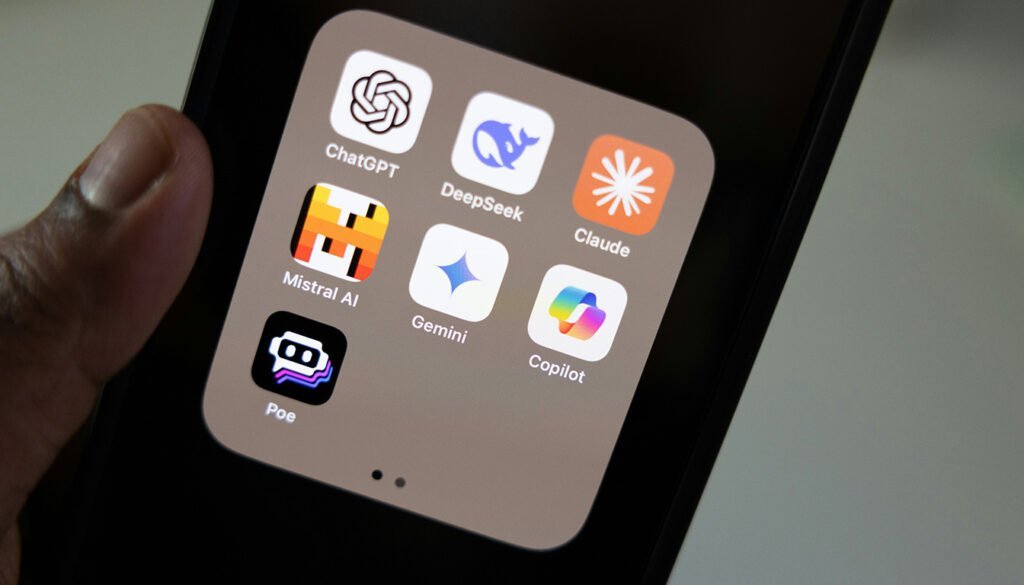
This Poe AI review 2026 tests Quora’s bet that the future of AI chat isn’t one model — it’s all of them, side by side. The app gives you a single subscription that unlocks GPT-class models, Claude, Gemini, Llama, Mistral, and dozens of specialized bots, letting you compare answers and pick the best model for each task — a different philosophy from the single-model apps in our best AI chatbots ranking. In 2026, with model releases coming faster than ever, that proposition is more appealing than ever. We tested Poe to see whether it’s the smart way to access AI — or just another subscription.
What Is Poe?
Poe (short for “Platform for Open Exploration”) is Quora’s AI chat app, launched in 2023 and steadily expanded since. The core idea is simple: instead of subscribing to ChatGPT Plus, Claude Pro, and Gemini Advanced separately, you pay Poe once and get access to all of them through a unified interface. You can chat with each model individually, compare two models’ answers side by side, or use community-created bots tuned for specific tasks like coding help, image generation, or language tutoring.
Quora’s angle is discovery — the same instinct that built a Q&A empire. Poe lets you find the right AI for the job the way Quora helps you find the right answer.
The Model Lineup

Poe’s roster in 2026 includes the heavy hitters and plenty of niche options:
- Flagship models: Current-generation GPT, Claude, and Gemini models, typically added within days of release.
- Open models: Llama, Mistral, Qwen, and DeepSeek variants for users who prefer open weights or lower costs.
- Specialized bots: Image generators (powered by models like Stable Diffusion and DALL-E-class systems), code assistants, and writing coaches.
- Community bots: Thousands of user-created bots with custom prompts — quality varies wildly, but the best are genuinely useful.
The lineup changes constantly as new models drop, which is both the point and a minor frustration: your favorite model today might be reorganized into a new bot name tomorrow.
Hands-On Testing: What We Actually Used

We ran Poe through a week of real work: drafting articles, debugging Python, summarizing research papers, and generating images. The multi-model comparison view was the standout feature — asking three models the same coding question and seeing Claude nail the architecture while GPT gave the cleaner implementation saved genuine time.
Response quality matches the native apps for each model, with one caveat: Poe sometimes lags a few days behind on brand-new model releases and feature updates (like new voice modes or canvas features). If you need day-one access to the latest flagship, the native subscription still wins.
The mobile app is excellent — clean, fast, and arguably better designed than most native AI apps. Desktop web is solid too, though power users will miss some advanced features like Claude’s artifacts or ChatGPT’s deep research mode, which don’t fully translate to Poe’s unified interface.
Pricing: The Math That Matters

| Plan | Cost | What You Get |
|---|---|---|
| Free | $0 | Limited daily messages on select models |
| Poe Subscription | ~$20/month | 1M compute points/month across all models; premium models cost more points per message |
Poe uses a points system: each message consumes points based on the model’s cost, with flagship models costing significantly more per message than smaller ones. One million points sounds like a lot, but heavy Claude or GPT-5-class usage can burn through it in a couple of weeks of intensive work. Light-to-moderate users will find it plenty.
The value proposition: one $20 subscription vs. $20 each for ChatGPT Plus, Claude Pro, and Gemini Advanced. If you regularly use two or more flagship models, Poe saves real money. If you’re loyal to a single model, subscribe to that model directly — you’ll get fuller features and no points anxiety.
Where Poe Falls Short
- Feature parity: Native app features (deep research, advanced voice, project workspaces) arrive late or never.
- Points anxiety: Watching points drain on expensive models discourages experimentation — the opposite of what a multi-model playground should do.
- Bot sprawl: The model list is cluttered with duplicates and deprecated versions; finding the current best requires attention.
- No API: Developers can’t build on Poe; it’s consumer-only.
Getting the Most From Your Points
The points system is Poe’s biggest learning curve. A few strategies from our testing:
- Default to cheaper models for drafts. Use a mid-tier model for brainstorming and first drafts, then spend flagship-model points on the final polish pass. The quality difference on rough work is negligible.
- Use comparison view selectively. Comparing three flagship models triples your point burn. Compare once to pick a winner for a task type, then stick with it.
- Check the points cost before long chats. Each bot’s page shows its per-message cost. A “cheap” model with a long context window can out-consume a flagship on marathon sessions.
- Track your monthly reset. Points reset monthly, not on a rolling basis. Heavy users should front-load big projects early in the cycle.
With disciplined model selection, our test account used roughly 400,000 of the 1,000,000 monthly points across a normal work month — comfortable headroom. Undisciplined flagship-only use hit the cap in 12 days.
Poe vs. Alternatives
- ChatGPT Plus ($20/mo): Better if you live in one ecosystem and want the newest features first.
- Claude Pro ($20/mo): Better for writers and coders who want Claude’s full capabilities.
- You.com / Perplexity: Better for AI search; Poe is better for pure model access.
- OpenRouter: Better for developers and API tinkerers; Poe is better for everyday chat use.
Pros and Cons
Pros
- One subscription for all major AI models
- Excellent side-by-side model comparison
- Fast model updates after releases
- Polished mobile and web apps
- Large library of community bots
Cons
- Points system limits heavy flagship-model use
- Native features lag behind official apps
- Cluttered, confusing model list
- No API access
Poe AI Review 2026: FAQ
How much does Poe cost?
Poe’s subscription is ~$20/month for 1M compute points usable across all models; flagship models cost more points per message. A limited free tier exists.
Which AI models are on Poe?
Current GPT, Claude, and Gemini flagships plus open models (Llama, Mistral, Qwen, DeepSeek) and thousands of community bots. The lineup updates frequently.
Is Poe better than ChatGPT Plus?
For multi-model users, yes — one subscription covers everything. For single-model loyalists who want day-one features, subscribe to that model directly.
Do points run out?
They can: heavy flagship-model use burned through our 1M points in 12 days; disciplined mixed use left headroom. Points reset monthly.
Does Poe have an API?
No — Poe is consumer-only. Developers should look at OpenRouter or direct provider APIs.
Poe AI Review 2026: Final Verdict
Poe is the best value in AI subscriptions for multi-model users in 2026. If your workflow touches two or more flagship models, the $20 subscription pays for itself immediately — and the comparison view alone is worth it for anyone choosing between models. Single-model loyalists should skip it. Everyone else: the free tier is worth a week of your time — especially if you’re still deciding between assistants in our ChatGPT vs Claude vs Gemini comparison.
Rating: 4 out of 5.
Get started at poe.com.


