
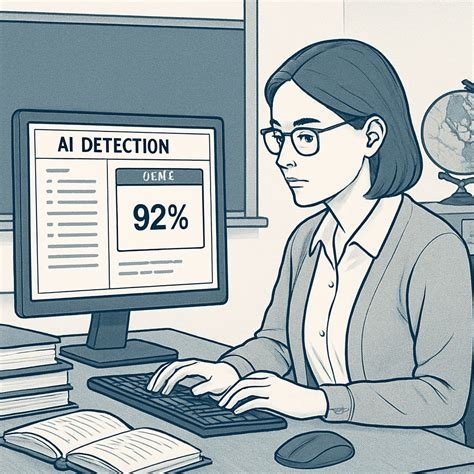
When teachers suspect AI-generated work, they turn to detection websites — and students should know what those tools are, what they claim, and (critically) how often they’re wrong. What websites do teachers use to check for AI? Here’s the honest rundown of the major detectors, their accuracy problems, and what the results actually mean.
The Major Detection Tools
Turnitin’s AI Detection
The 800-pound gorilla — integrated into the plagiarism checker most schools already use. Turnitin’s AI detector claims high accuracy, and independent testing suggests it’s among the better detectors available. But “among the best” still means meaningful false-positive rates, and Turnitin itself has acknowledged limitations. Key fact: many schools enabled it by default, meaning teachers may be seeing AI scores they never asked for — and acting on them without understanding the error rates.
GPTZero
Built specifically for educators, GPTZero analyzes “perplexity” and “burstiness” — roughly, how predictable the text is and how much sentence length varies. Human writing is bursty and unpredictable; AI writing is smooth and uniform. It’s free for basic use, which made it hugely popular. But the underlying signals are gameable (ask AI to “write with varied sentence lengths and occasional fragments” and scores drop), and false positives on non-native English speakers are well documented.
Originality.ai, Copyleaks, Winston AI
The commercial tier: paid detectors marketed to educators and publishers with claims of 95%+ accuracy. Independent evaluations consistently find real-world accuracy lower than marketed — especially on edited AI text, mixed human-AI writing, and non-native English. They have their uses as screening tools; they’re not verdict machines.
Free online checkers (various)
Dozens of free “AI detector” websites exist with wildly varying quality. Many are essentially random on short texts. Teachers using random free checkers found via Google are working with the least reliable tier of an already unreliable category.
How Reliable Are They? The Uncomfortable Truth
Here’s what the research actually shows, and every teacher and student should know it:
- False positives are real and common. Studies have found detectors flagging human-written text as AI-generated at rates from 5% to over 20% depending on the tool and text type. Non-native English speakers are disproportionately flagged — their more formal, careful writing patterns resemble AI’s.
- They’re trivially defeated. Light editing, paraphrasing tools, or simply prompting the AI to “write in a casual, varied style” defeats most detectors. A detection system that catches only the lazy and the innocent is worse than useless — it’s unjust.
- Short texts are unreliable. Most detectors need substantial text length for meaningful analysis. Short answers and paragraphs produce essentially random results.
- Mixed writing confuses them. Human-edited AI text, AI-assisted human text — the realistic middle ground — is where detectors perform worst.
- They can’t detect the newest models well. Detectors lag behind generators; each model generation initially fools existing detectors.
What Websites Do Teachers Use to Check for AI — What Should They Do Instead?
The responsible approach, and what updated integrity policies increasingly require:
- Treat detector scores as leads, never verdicts. A high AI score means “look closer,” not “guilty.” This should be explicit policy, not individual judgment.
- Use process evidence. Drafts, version history, in-class writing samples for comparison — the forensics from authorship checking applied to essays.
- Talk to the student. “Walk me through your argument here” resolves most cases. Students who wrote it can discuss it.
- Redesign assessments. The structural fix: process portfolios, in-class components, personalized prompts that make detection unnecessary.
Students facing accusations need the false-accusation playbook — process evidence is the defense that works.
The Bigger Picture
The detection arms race is a losing game — generators will always outpace detectors, because generating human-like variation is easier than detecting its absence. The institutions adapting well are investing in assessment that doesn’t need detection: measuring understanding directly through process, discussion, and in-class work. The institutions buying detector subscriptions are buying a false sense of security that generates real injustice along the way. Teachers deserve better tools than statistical guesses; students deserve better than being judged by them.
For Students: Understanding Your Rights
If you’re a student reading this, here’s what matters practically. Know your school’s policy: what does it actually say about AI detection? Many policies are vaguer than students assume — read the real document, not the rumor. Detector scores are not proof: if you’re accused based on a score alone, that’s a weak accusation, and established research backs you up. Politely ask what evidence beyond the score exists.
Protect yourself proactively: write in Google Docs with version history on, keep your outlines and drafts, save your research notes. This isn’t about distrust — it’s the academic equivalent of keeping receipts, and it takes zero extra effort once it’s habit. If falsely accused: stay calm, ask for specifics, present your process evidence, respond in writing, and use the formal appeal process if needed. The full playbook is in our guide to fighting false AI accusations — students with documented processes almost always prevail.
The deeper point: the healthiest student response to the detection era isn’t evasion techniques — it’s genuine learning plus documented process. Students who actually do the work and keep their drafts are bulletproof: nothing to hide, everything to show. And frankly, that’s also just… being a good student. The detection debate will eventually fade as assessment improves; the habits of real learning and honest process keep paying off forever.
The Takeaway
Teachers use Turnitin, GPTZero, Originality.ai, Copyleaks, and various free checkers — but all detectors have significant false-positive rates, are easily defeated, and struggle with non-native English and short texts. Detector scores are investigative leads, never verdicts. The real solution is better assessment design, not better detection.
Research: AI content detection limitations — the documented accuracy problems.



