
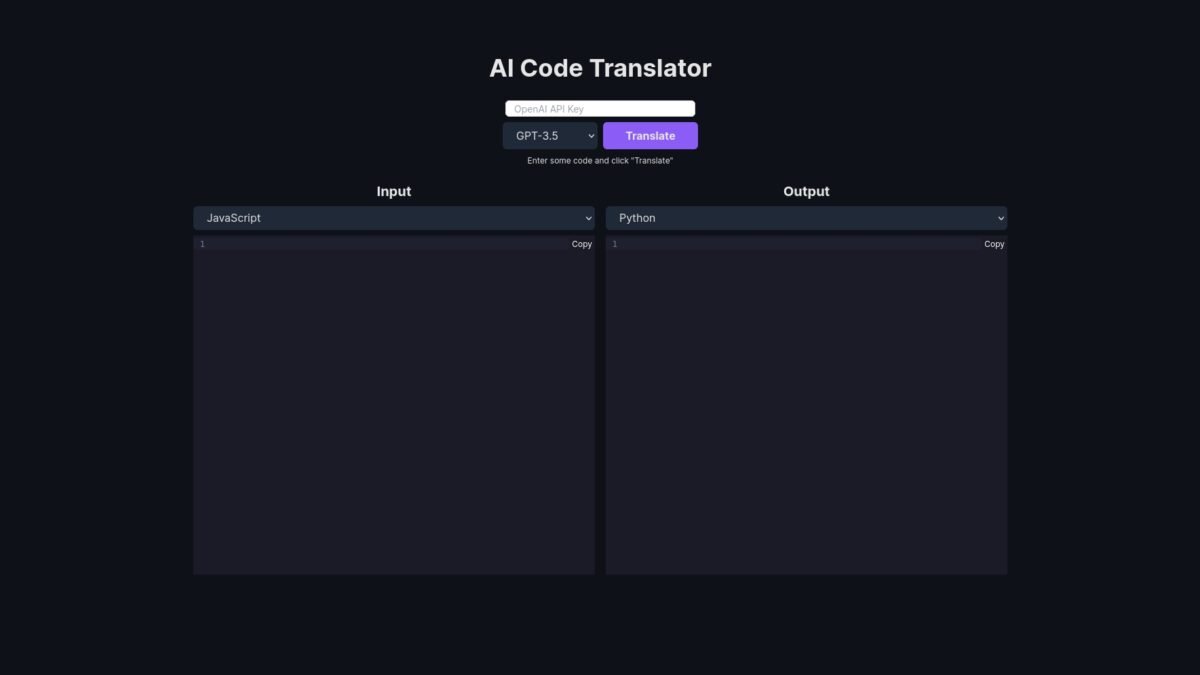
Porting code between languages used to be the most tedious job in programming — line by line, library by library, cursing the differences. Now AI does the first 80% in seconds. But how to convert code between languages with AI without introducing subtle, horrible bugs? That’s the real skill, and most people get it wrong by feeding in too much at once.
The Chunk Method: How to Convert Code Between Languages With AI Reliably
Don’t paste 2,000 lines and say “convert to Go.” The AI will lose track of state, invent helpers, and silently drop edge cases. Instead:
- Convert in logical chunks. One function or module at a time, 50–150 lines. The AI holds context much better at this size.
- Specify the idiom, not just the language. “Convert this Python to idiomatic Rust — use Result types, avoid unwrap, follow clippy conventions.” Language alone isn’t enough; every language has a “right way” and AI defaults to the easy way.
- List the tricky dependencies. “The Python uses numpy and pandas — map these to the closest Go equivalents and flag anything with no equivalent.”
- Demand tests. Ask for unit tests alongside the conversion, then run both versions against the same inputs. Behavior parity is the only proof that matters.
Watch for the classic failure modes
AI translations have signature bugs: fake APIs (it invents a library function that doesn’t exist — see why AI invents fake libraries), idiom drift (Pythonic code wearing a Java costume), and silent semantic changes (integer division behaves differently across languages; so do string encodings, date handling, and floating point). The fixes are mechanical: compile, run the tests, diff the outputs. For framework-level moves, the same discipline applies as in framework migrations.
When It Works Brilliantly vs. When to Be Careful
AI shines converting straightforward logic: data transformations, CRUD endpoints, utility functions, algorithms. It struggles with: concurrency models (async Python → Go channels is a redesign, not a translation), performance-critical code (idiomatic ≠ fast), and anything touching platform-specific APIs. For those, use AI to draft, then hand-tune.
And the golden rule from stopping AI code hallucinations applies double here: verify every library call in the target language’s docs. A converted codebase that “looks right” but calls phantom functions is worse than no conversion at all.
Language Pairs: What Converts Well and What Doesn’t
Not all conversions are created equal. Python ↔ JavaScript/TypeScript converts beautifully — similar abstraction levels, huge training data, well-understood idioms. Java ↔ C# is nearly mechanical. Anything → Go works well for logic but needs human review on error handling, since Go’s explicit error returns are a different philosophy, not just different syntax.
The hard pairs are where paradigms shift. OOP → Rust isn’t a translation; it’s a redesign around ownership and the borrow checker. AI can draft it, but expect to rethink data structures. Synchronous → async (in any language) similarly requires architectural thought — sprinkling async keywords produces code that compiles and deadlocks. Anything → C demands manual memory management decisions that no AI should make unsupervised.
Practical rule of thumb: if the conversion is mostly syntax and standard-library mapping, AI handles 80–90% and you review. If it involves a paradigm shift — memory model, concurrency model, type system philosophy — treat AI output as a first draft of a redesign, and budget real engineering time. The honest estimate to give your manager: AI cuts porting time roughly in half on easy pairs, and by maybe a third on hard ones. Still worth it, but not magic.
The Verification Checklist
Tape this to your monitor during any conversion project. For every converted module: it compiles cleanly with strict settings (warnings as errors if you can). Unit tests pass — the same tests, ported, asserting identical behavior on identical inputs. Dependencies verified — every library call checked against the real target-language docs, not the AI’s memory. Edge cases probed — empty inputs, nulls, unicode, boundary values, the inputs the original code handled that you forgot about.
Performance sanity-checked — run a benchmark on both versions; conversions that are 10x slower usually hide an algorithmic mismatch (like using a list where the original used a hash map). Reviewed by a human who knows the target language — ideally someone who’ll maintain it. AI conversions reviewed only by the converter tend to keep the converter’s blind spots. Check every box, and the converted codebase earns its place. Skip boxes, and you’re shipping hope.
Try this today: pick one small utility module (under 100 lines) and convert it using the chunk method — explicit idiom instructions, dependency mapping, tests on both sides. You’ll learn more about both languages from one careful conversion than from a week of tutorials.
The Takeaway
Small chunks, explicit idioms, dependency mapping, and test-verified parity. Follow that and AI turns a month-long port into a week-long review job. Skip it and you get a codebase that compiles but lies.
Reference: the Wikipedia overview of source-to-source translation is a solid conceptual background read.




1 Comment