
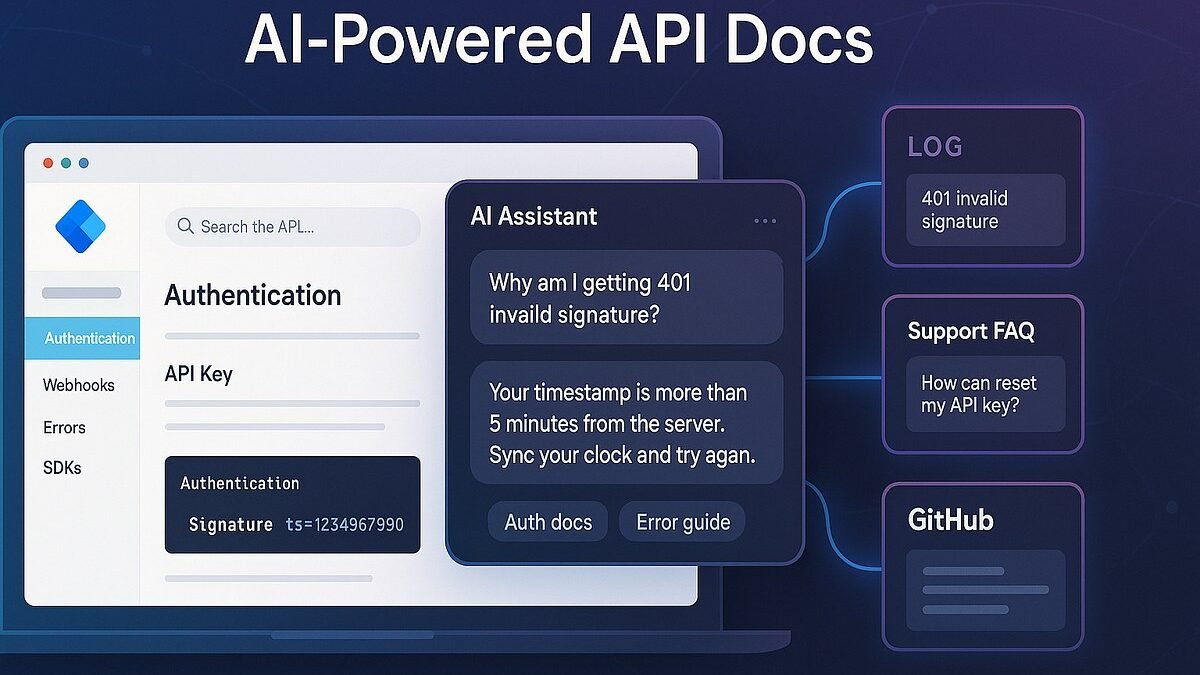
Nobody writes API docs. Everyone suffers from missing API docs. This is one of those problems AI solves so well it feels unfair. Generating API documentation with AI takes the job from “weekend I’ll never get back” to “afternoon with coffee” — but only if you feed it right and verify the output. Auto-generated docs that lie are worse than no docs at all. This guide covers How to generate API documentation with AI — clearly, honestly, and without the fluff.
How to Generate API Documentation With AI: The Workflow
- Feed it the source of truth. Route handlers, controllers, models — the actual code, not your memory of the code. Docs generated from memory describe the API you wish you had.
- Ask for OpenAPI/Swagger first. “Generate an OpenAPI 3.1 spec for these Express routes.” A machine-readable spec can then render into Swagger UI, Redoc, or any docs portal — and it doubles as a contract for testing.
- Then ask for human docs. “Now write developer-friendly documentation from this spec: overview, auth, each endpoint with example requests and responses, error codes, rate limits.”
- Demand examples that run. “Include curl examples for each endpoint.” Then actually run them. An example that 404s destroys trust instantly.
What to include in the prompt
Give the AI: the code, the auth scheme, the base URL, any non-obvious business rules (“the `status` field can only transition forward”), and deprecated endpoints to mark clearly. The AI can’t document tribal knowledge it can’t see.
Verification: The Part Everyone Skips
AI docs have characteristic lies: invented query parameters, wrong status codes, optimistic descriptions of what an endpoint returns. Verify mechanically:
- Run every example request. All of them.
- Diff the spec against the code for a sample of endpoints.
- Have a developer who’s never used the API try to integrate from the docs alone. Their confusion is your bug list.
This verification discipline is the same one behind explaining legacy code accurately — and while you’re at it, make sure your docs generation isn’t leaking secrets into examples (real API keys in docs happen more than anyone admits).
Keeping Docs in Sync (The Real Hard Problem)
Generating docs once is easy. Keeping them accurate as the API evolves is the actual problem — stale docs are arguably worse than no docs because they actively mislead. The fix is process, not heroics: generate from code, not from memory, every time. If your docs pipeline starts from the actual route definitions, drift becomes visible immediately.
The mature setup: your OpenAPI spec is generated in CI from code annotations or route inspection, AI assists in writing the human-friendly descriptions and examples, and a docs check runs on every PR that touches endpoints. When the spec and the code disagree, the build complains. This turns documentation from a periodic chore into a continuous property of the codebase.
And assign ownership. “Everyone owns the docs” means nobody does. One person (or a small rotation) reviews docs diffs the way they review code diffs. With AI doing the writing and CI doing the drift detection, the human job shrinks to curation — reviewing AI-drafted updates for accuracy and tone. That’s a sustainable job. “Rewrite the docs every six months from scratch” is not, which is why nobody did it before AI existed.
What Great API Docs Look Like
Study the best before generating your own. Stripe’s docs are the gold standard: every endpoint has a working example, errors are documented as carefully as successes, and you can go from zero to first API call in minutes. Twilio’s are excellent at progressive disclosure — quickstart for the impatient, depth for the committed. Notice what they share: runnable examples, honest error documentation, and clear auth instructions up front.
Now hold your AI-generated docs to that bar with a simple test: hand them to a developer who’s never seen your API and time how long until their first successful call. Under 15 minutes? You’re in good shape. Over an hour? Your docs have gaps — usually in auth setup or error handling, the two places AI-generated docs are weakest because they require tribal knowledge. Feed that knowledge back into the prompt (“our auth requires these three headers, here’s why”) and regenerate. Great docs are a loop, not a document.
Your next step: generate the OpenAPI spec for your most-used endpoints this week, verify every example by running it, and publish. “Docs that exist” beats “perfect docs someday” — ship the 80% now.
Lastly: docs are a product, and your API’s users are customers. Every hour you invest in accurate, example-rich documentation pays back in fewer support tickets and faster integrations. AI just made that hour dramatically cheaper.
The Takeaway
Code → OpenAPI spec → human docs → verified examples. AI does the writing; you do the verifying. The result: documentation that exists, which puts you ahead of roughly 80% of APIs out there. For related code-transformation work, converting code between languages uses the same feed-truth-verify-truth loop.
Standard reference: the OpenAPI specification — know what good looks like before generating it.



