
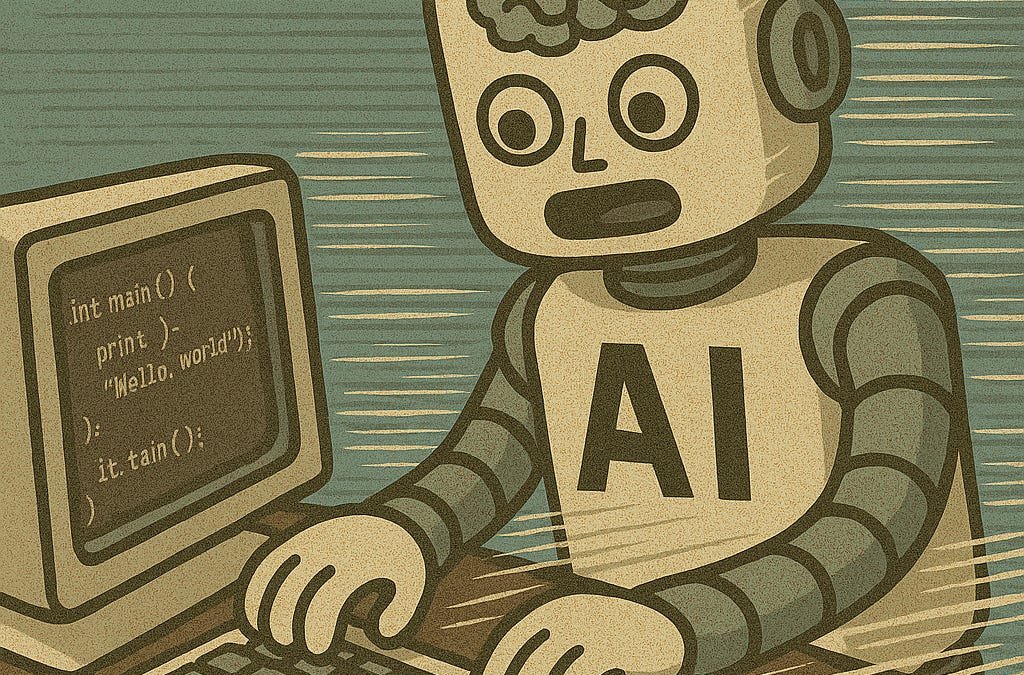
Of everything AI does, coding is where it seems almost unfairly capable. It writes poetry that’s mediocre and code that’s genuinely useful. Why is AI so good at coding? It’s not one reason — it’s a perfect storm of properties that make programming uniquely suited to how language models work. Understanding the reasons also reveals the limits, which is where the interesting part lives.
Why is ai so good at coding? Here’s Why
1. Code is structured and formal
Human language is ambiguous; code isn’t (mostly). Programming languages have precise grammars, and models — which are fundamentally pattern engines — thrive on precise patterns. The stricter the structure, the better the prediction. This is why AI writes better Python than poetry: Python has rules; poetry has vibes.
2. Absurd amounts of training data
GitHub alone hosts hundreds of millions of repositories. Stack Overflow has 20+ million questions. Documentation, tutorials, blog posts — code is the most abundant high-quality structured text on the internet, and models trained on all of it. When you ask for a sorting algorithm, the model has seen it implemented ten thousand ways.
3. Code is instantly verifiable
This is the underrated one. A poem’s quality is subjective; code either runs or it doesn’t. This verifiability creates a flywheel: models can be trained with feedback from compilers and test suites (not just human preferences), and users can verify output in seconds. Few domains offer this tight a feedback loop.
4. Programming is pattern-heavy
Most code isn’t novel — it’s CRUD endpoints, auth flows, data transformations, the same patterns recombined. Models excel at pattern recombination. The 80% of coding that’s “seen this before” is exactly where AI dominates.
5. Precise vocabulary, limited ambiguity
“Write a function that sorts a list” has far less interpretive wiggle room than “write something beautiful.” Clear specifications in, correct implementations out — when the request is precise, which is a skill in itself.
Why These Reasons Define the Limits Too
Flip each reason and you get the failure modes: novel architecture (no patterns to remix) is where AI flounders. Ambiguous requirements produce confident wrong code. Unverifiable domains (is this UX good? is this the right product?) get no flywheel benefit. That’s why professionals use AI for the pattern-heavy 80% and keep humans on the novel 20% — and why autonomous coding works for scoped tasks but not for “design our system.”
It also explains why verification matters so much: hallucinated functions happen precisely because the model is such a fluent pattern-producer — fluency without grounding. The better you understand why AI is good at code, the better you get at knowing when to trust it and when to double-check.
What This Means for Learning to Code in 2026
If AI is this good at the pattern-heavy 80% of coding, what should humans learn? More fundamentals, not fewer. The better AI gets at generating code, the more valuable the judgment to direct and verify it becomes — and judgment comes from understanding fundamentals deeply. Data structures, algorithms, system design, debugging: these aren’t obsolete; they’re the leverage layer.
Learn to specify precisely. “Clear specifications in, correct implementations out” means the skill of decomposing problems and stating requirements exactly is now a programming skill. Learn to verify ruthlessly. Reading code critically, writing tests, reasoning about edge cases — the skills AI can’t do for you. Learn the novel 20%. Architecture, product thinking, debugging the truly weird — the territory where patterns run out. The programmers thriving in the AI era aren’t the fastest typists; they’re the clearest thinkers. That was always true. AI just made it obvious.
The Other Side: What AI Is Bad At (And Why That Matters More)
Understanding AI’s coding strengths is useful; understanding its weaknesses is career-defining. Requirements gathering — figuring out what to build from vague human needs — is profoundly human. AI can’t sit in a meeting, read the room, and realize the client is asking for the wrong thing. Debugging novel systems — when the bug is in the interaction of five components in a way nobody’s seen before, pattern-matching fails and first-principles reasoning takes over. Technical taste — knowing which solution is elegant, maintainable, and right for this team isn’t pattern recognition; it’s judgment built from experience.
Accountability and ownership — someone has to sign off, take the 3 AM call, and answer for the outage. That someone is human, permanently. Here’s why this matters more than the strengths: the strengths are commoditizing (everyone gets the same code generation) while the weaknesses are differentiating (judgment, taste, and ownership can’t be downloaded). The developers who fixate on “AI writes code now, what do I do?” are asking the wrong question. The right one: “What parts of software engineering were never about writing code?” — and then getting excellent at those. Requirements, architecture, debugging, taste, ownership. That was always the real job. AI just stripped away the typing and revealed it.
The Takeaway
AI excels at coding because code is structured, abundant in training data, instantly verifiable, pattern-heavy, and precisely specified. Those same properties define its limits: novelty, ambiguity, and judgment remain human territory. Work with the grain — AI for patterns, you for decisions — and the combination is formidable.
Deeper dive: how large language models work on Wikipedia connects these dots technically.



