
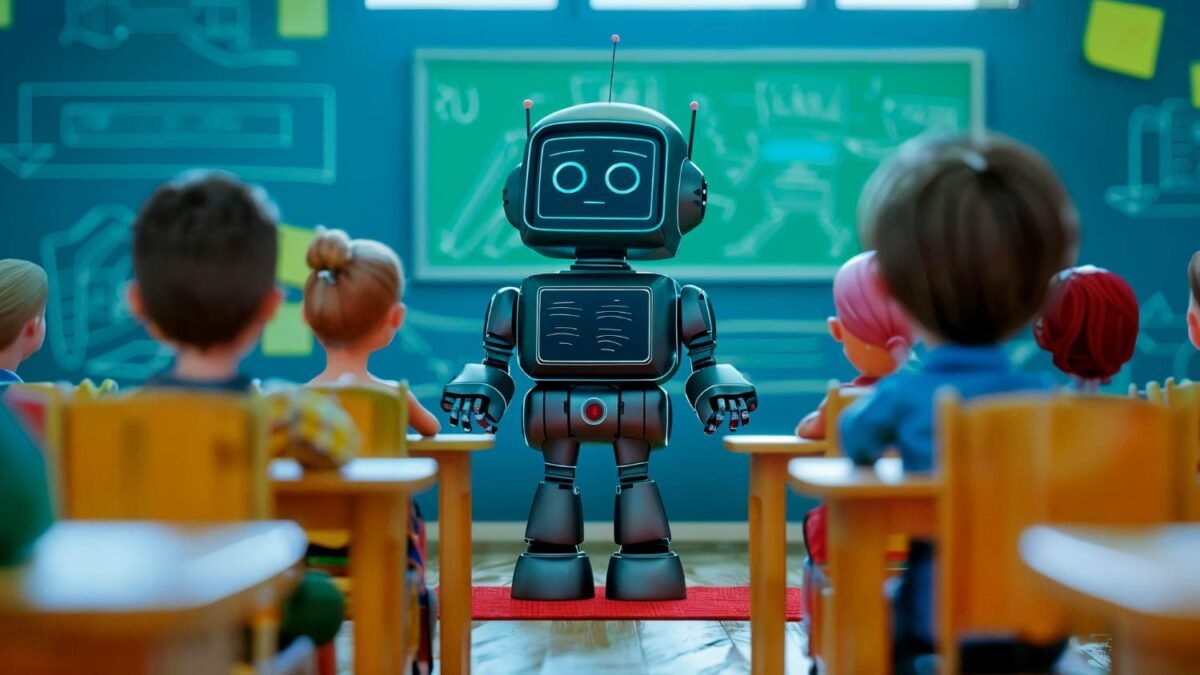
The debate often frames AI in schools as a risk to manage. Flip the frame: why should AI be used in schools — what’s the positive case, the opportunity that cautious schools are leaving on the table? It’s substantial, and it goes far beyond “students like it.” Here are the real reasons, from learning science to equity to plain practicality.
Why should ai be used in schools? Here’s Why
Education has promised personalization for decades and delivered it to almost no one — it’s just too labor-intensive for one teacher with 30 students. AI changes the economics fundamentally. Every student gets a tutor: infinite patience, adapts to pace, available at midnight before the exam. The research on tutoring is unambiguous — Bloom’s famous “2 sigma problem” showed tutored students outperform classroom students by two standard deviations. We’ve never been able to afford tutors for everyone. Now we can approximate it.
Differentiation becomes feasible: the same lesson at five reading levels, practice problems calibrated to each student’s gaps, enrichment for the advanced and scaffolding for the struggling — generated in minutes. Teachers have always known differentiation works; AI makes it doable. Pacing adapts: fast students accelerate instead of waiting; struggling students get more practice instead of being dragged along. The lockstep classroom — everyone on page 47 together — was always a logistical compromise, not a pedagogical ideal.
2. Teacher Time Returned to Teaching
The average teacher spends 10–15 hours weekly on tasks AI handles well: lesson planning, grading support, differentiation, parent emails, reports. Reclaim even half of that and you’ve returned hundreds of hours yearly to actual teaching — the one-on-one help, the thoughtful feedback, the relationship-building that no AI can do. This isn’t about efficiency for its own sake; it’s about redirecting human expertise to where humans matter most. The admin time-savings are the least controversial, most immediate win in all of AI-in-education.
3. Equity (If Done Right)
Used thoughtfully, AI narrows gaps: the student without access to private tutoring gets an AI tutor. The ESL student gets instant translation and scaffolding. The rural school without AP teachers gets AP-level support. The special needs student gets differentiation their under-resourced school couldn’t provide. These aren’t hypotheticals — they’re happening now in schools that deployed thoughtfully.
The caveat is real: done carelessly, AI widens gaps (paid tiers, device access, digital literacy all correlate with privilege). Which is why the equity case is an argument for intentional, school-provided AI access — not for leaving it to chance. Schools that provide AI tools equitably are doing equity work; schools that ban AI while wealthy families buy it privately are doing the opposite.
4. Workforce Readiness (Non-Negotiable)
Graduates are entering workplaces where AI fluency is assumed — like computer literacy in 2000 or internet literacy in 2010. A school that doesn’t teach AI use isn’t protecting students; it’s disadvantaging them relative to peers whose schools did. The specific skills — directing AI tools, verifying output, knowing when to trust and when to think independently — are now core employability skills. Students should be learning these; schools are where that learning should happen, guided by educators rather than figured out alone.
5. Better Learning Science, Actually Applied
We know what works in learning: retrieval practice, spaced repetition, interleaving, elaborative interrogation, the Feynman technique. We just couldn’t implement them at scale — they require personalization and effort. AI implements them naturally: adaptive quizzing, spaced scheduling, Socratic tutoring. The schools using AI well aren’t just adding technology; they’re finally applying decades of learning science that was always too labor-intensive before. That’s the deepest reason of all.
Answering the Objections Honestly
“Students will cheat.” Some will — and bans don’t stop them. Assessment redesign does. “It’ll make students dependent.” Only if taught badly; taught well, it’s the opposite — AI tutelage builds independence faster. “We can’t afford it.” The best tools have free tiers; the costliest part is teacher training, which is an investment with massive returns. “It’s unproven.” Tutoring, retrieval practice, and formative feedback are among the most proven interventions in education — AI just delivers them scalably. The objections deserve answers, and they have them.
What Thoughtful Implementation Looks Like
The case for AI in schools is strong — but how schools implement it determines whether the promise materializes. Start with teachers, not students: train educators first, thoroughly, with paid time. Teachers who are confident with AI guide students well; teachers who aren’t either ban it or misuse it. The training investment is the highest-ROI line item in any school AI budget.
Provide equitable access: school-provided tools, device access, and connectivity — so AI benefits don’t track family income. If only some students have AI tutors at home, the school must provide them to all, or the equity case inverts. Redesign assessment alongside adoption: don’t bolt AI onto 2019 assessments and wonder why cheating spikes. Process portfolios, in-class verification, AI-inclusive tasks — the assessment redesign is the implementation, not a follow-up.
Teach AI literacy explicitly: how models work, hallucination, verification, prompting, ethics, privacy — as curriculum, integrated across subjects. Protect privacy by design: vetted tools, anonymization habits, clear policies — the full privacy playbook, not afterthoughts. Measure what matters: are students learning more? Are teachers saving time? Are gaps narrowing? Track the outcomes the case promises, and adjust when they don’t materialize. Include the skeptics: the teachers with concerns often see real risks the enthusiasts miss. Implementation designed with skeptics is more robust than implementation that steamrolls them. The case for AI in schools isn’t “adopt blindly” — it’s “adopt thoughtfully, because the opportunity cost of waiting is measured in student learning.”
The Takeaway
AI belongs in schools because it finally makes personalization scalable, returns teacher time to teaching, advances equity when deployed intentionally, prepares students for the workplace they’ll enter, and applies learning science at scale. The question was never whether AI would enter education — it’s whether schools will shape that entry or be shaped by it. How curricula are adapting shows the path forward.
Evidence base: UNESCO’s AI in education research.



