
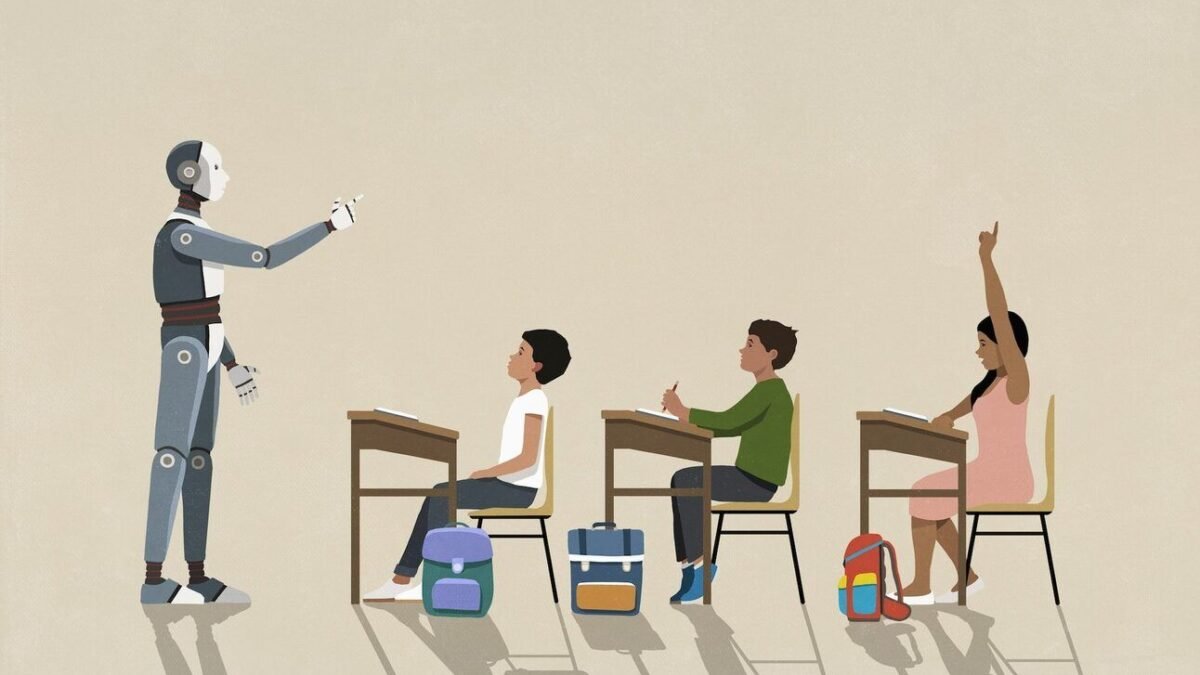
Walk into a forward-thinking school in 2026 and you’ll notice the changes aren’t about robots in classrooms — they’re subtler and more important. How are schools adapting curricula for the AI era? The honest answer: unevenly, experimentally, and faster than the headlines suggest. Here’s what’s actually changing in curricula around the world.
How are schools adapting curricula for the AI era: The Full Breakdown
The biggest curricular addition: AI literacy — teaching students how AI works, where it fails, and how to use it well. Leading curricula cover: how language models actually work (prediction, not knowledge), hallucination and verification habits, effective prompting as a communication skill, data privacy, and the ethics of AI use. Some districts start this in middle school; others integrate it across subjects rather than as a standalone course.
The integrated approach is winning: AI literacy inside existing subjects. English classes analyze AI-generated text critically. Science classes verify AI explanations against experiments. History classes discuss AI’s training-data biases. This beats a standalone “AI class” because it teaches the key lesson — AI is a tool you use within disciplines, judged by disciplinary standards.
Change 2: Assessment Redesign (The Quiet Revolution)
This is the most consequential change and the least visible. Schools are redesigning how they measure learning because AI broke the old methods:
- Process over product. Drafts, revision histories, and reflection journals count more; the final artifact counts less. You can’t fake a process portfolio easily.
- In-class and oral components. Timed in-class writing, oral defenses, and live problem-solving verify understanding directly.
- Personalized prompts. Assignments tied to class discussions, local contexts, or personal experience resist generic AI output.
- AI-inclusive assessments. Some pioneering teachers now require AI use — “use AI to research, then critique its output” — assessing the judgment, not the generation.
This connects directly to updating academic integrity policies — curriculum and policy are evolving together.
Change 3: Skills Emphasis Shift
Curricula are quietly reweighting which skills matter most:
- Up: critical thinking, verification, prompt engineering (precise communication), ethical reasoning, creativity, collaboration, and metacognition (thinking about thinking).
- Down (in emphasis, not eliminated): rote memorization, formulaic writing, and any skill that’s purely “produce X in format Y” — the things AI does adequately.
- New: human-AI collaboration as an explicit skill — knowing when to delegate to AI, when to verify, when to think alone.
What’s NOT Changing (And Shouldn’t)
Foundational knowledge still matters — you can’t verify AI output about things you don’t understand, and you can’t think critically in a vacuum. Math fundamentals, reading comprehension, writing ability, scientific method: these are the substrate AI literacy builds on, not replaces. The schools getting this right are adding AI-era skills to strong foundations, not swapping one for the other. Why AI belongs in schools makes the case; changing teacher training covers the educator side.
Case Studies: Schools Doing It Well
The abstract becomes concrete in specific schools. Singapore’s approach: AI literacy integrated nationally across subjects, with teacher training to match — a top-down model showing what systematic integration looks like when the will exists. Finland’s phenomenon-based learning: already organized around interdisciplinary projects rather than siloed subjects, Finnish schools adapted naturally — AI slots into project work as a research and creation tool, and the assessment was already portfolio-based. U.S. innovators: individual districts like those in California and Texas piloting “AI literacy graduation requirements” — students must demonstrate critical AI use to graduate.
The Khan Academy model: Khanmigo-style AI tutors deployed as supplements to teaching, not replacements — Socratic tutoring that asks questions rather than giving answers, deliberately designed around learning science. What the best cases share: teacher training came before student rollout (the opposite of the usual tech-in-schools pattern), assessment was redesigned alongside curriculum (not as an afterthought), and equity was designed in from the start (device access, offline options, free tiers). The schools struggling are the ones that bought tools without training teachers or rethinking assessment. The pattern is consistent across continents: curriculum adaptation succeeds when it’s pedagogy-led — starting from “what should students learn?” and asking how AI serves that — and fails when it’s technology-led, starting from the tool and searching for a use.
What to watch next: graduation requirements. The moment AI literacy becomes a diploma requirement — as a few pioneering districts have done — the laggards will scramble. If you’re an educator, don’t wait for the mandate: start integrating AI literacy into your subject now, one unit at a time. The schools leading this transition weren’t ordered to; they decided to.
The Takeaway
Schools are adding AI literacy (increasingly integrated into subjects), redesigning assessments around process and in-class verification, and reweighting skills toward judgment and critical thinking — all on top of unchanged foundations. The transition is uneven, but the direction is clear: education is shifting from “produce the answer” to “demonstrate the understanding.”
Policy context: UNESCO’s AI in education guidance tracks global curriculum developments.



