
Should students use AI? In 2026, this question is a bit like asking whether students should use calculators in 1985 — the debate feels settled everywhere except the faculty lounge. But “yes” needs qualification, because how students use AI determines whether it builds them up or hollows them out. Here’s the balanced answer for students, parents, and teachers.
Should students use ai? The Honest Answer
- The workplace already assumes it. Employers expect graduates who can wield AI tools productively. Graduating AI-illiterate in 2026 is like graduating computer-illiterate in 2000.
- Personalized tutoring at scale. A student stuck at 11 PM previously had no help; now they have an infinitely patient explainer. That’s an equity win, not a cheat code.
- Leveling the playing field. Students without access to private tutors gain something close to one. Used well, AI narrows gaps rather than widening them.
- Learning faster is a superpower. The students using AI as a tutor — quizzing, explaining, practicing — are genuinely learning more per hour. That’s the whole point of school.
The Case for Caution: Real Risks
- Dependency. The student who can’t write a paragraph or solve a problem without AI hasn’t learned — they’ve outsourced. Skills atrophy is real and measurable.
- Shallow learning. AI makes it easy to feel productive while learning nothing — the “I read the AI’s explanation, so I understand it” illusion.
- Equity in reverse. Paid tiers are better than free tiers. If AI becomes essential, the gap between $0 and $20/month matters.
- Misinformation. AI confidently states falsehoods. Students without verification habits absorb them.
The Framework: Use AI for Learning, Not Instead of Learning
The line that resolves every case: is the AI doing the thinking, or supporting your thinking? Tutor, quizzer, explainer, brainstorming partner, feedback-giver — all firmly on the right side. Ghostwriter, answer machine, “do my assignment” — wrong side. This is the heart of responsible student AI use and the real answer to whether it’s cheating.
For the institutional view — why schools themselves should embrace rather than ban — see why AI should be used in schools. The schools getting this right teach AI literacy explicitly: how the tools work, where they fail, and how to verify. That’s the curriculum addition that matters most.
What Parents Should Actually Do
Parents, the worst strategies are prohibition (unenforceable, breeds secrecy) and indifference (misses the risks). The productive middle: learn the tools yourself — spend one evening with ChatGPT and Claude. You can’t guide what you don’t understand, and you’ll be surprised how quickly you see both the value and the pitfalls. Talk about the line — not as a lecture but as a conversation: “When does using AI stop being helpful and start being cheating?” Kids who’ve thought about this make better calls than kids who’ve only been told rules.
Watch for dependency, not usage. The warning sign isn’t “my kid uses AI” — it’s “my kid can’t do homework without AI.” If you see that, the fix isn’t banning; it’s structured practice without the tool, rebuilding the underlying skill. Model good use yourself. Use AI visibly for your own learning and work, narrating your verification habits. Kids copy what they see more than what they’re told. The goal isn’t an AI-free childhood — it’s a childhood that produces an adult who wields AI with judgment.
The School Policy Landscape (What’s Actually Happening)
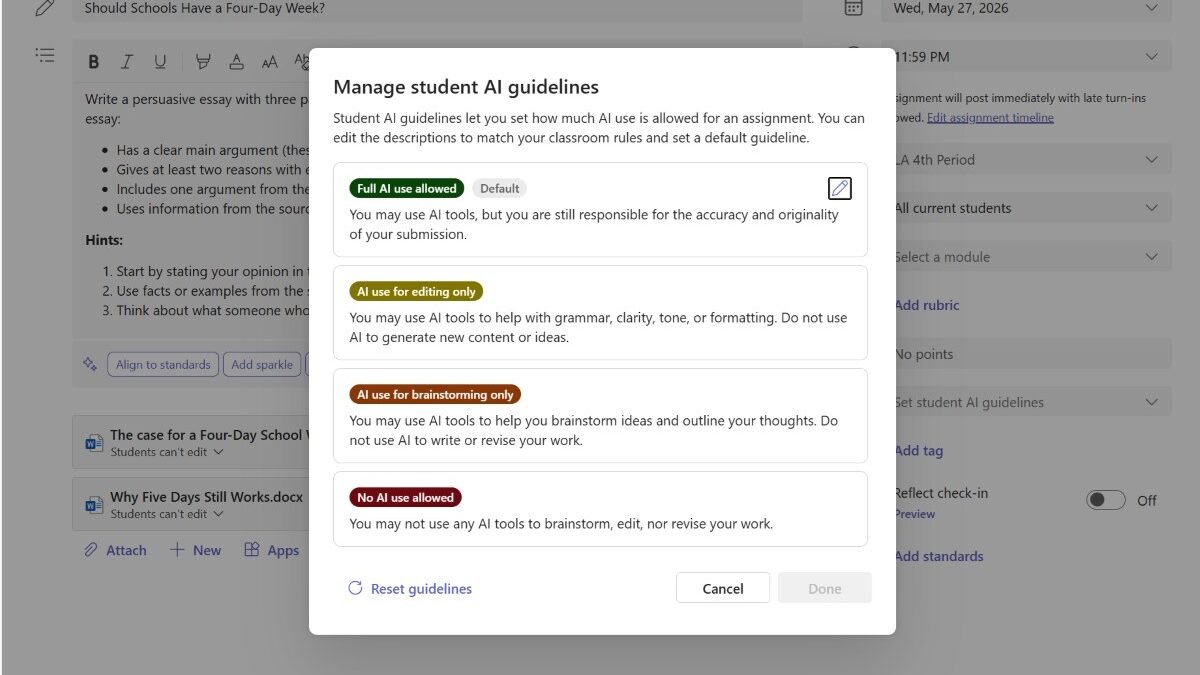
Behind the “should students use AI” debate, schools are converging on a practical consensus — and it’s not prohibition. The ban wave failed. Early 2023 saw districts banning ChatGPT outright; most quietly reversed within a year. Bans were unenforceable (students used phones), inequitable (savvy students circumvented them), and educationally backward (graduating students into an AI workplace without AI literacy). The current model: guided integration. Leading schools now teach AI literacy explicitly — how models work, where they fail, how to verify — and redesign assessments around process rather than product.
What’s emerging as best practice: clear use policies per assignment (not blanket bans), AI literacy as curriculum (starting surprisingly young in some districts), teacher training (the bottleneck — most teachers got zero AI training and are figuring it out alone), and assessment redesign (in-class work, orals, portfolios). What parents should know: if your school still has a blanket ban, it’s probably not working and probably not teaching your kid the judgment they’ll need. The productive question at the next PTA meeting isn’t “how do we stop AI?” but “how are we teaching students to use it well?” Schools that answer the second question are preparing students; schools stuck on the first are just delaying the inevitable.
The Takeaway
Yes, students should use AI — as a tutor, not a ghostwriter. The benefits (personalized help, faster learning, workplace readiness) outweigh the risks when students learn the judgment to use it well. Teach the judgment explicitly, and the question answers itself.
For parents: Common Sense Media has thoughtful, non-panicky guidance on kids and AI.




1 Comment