
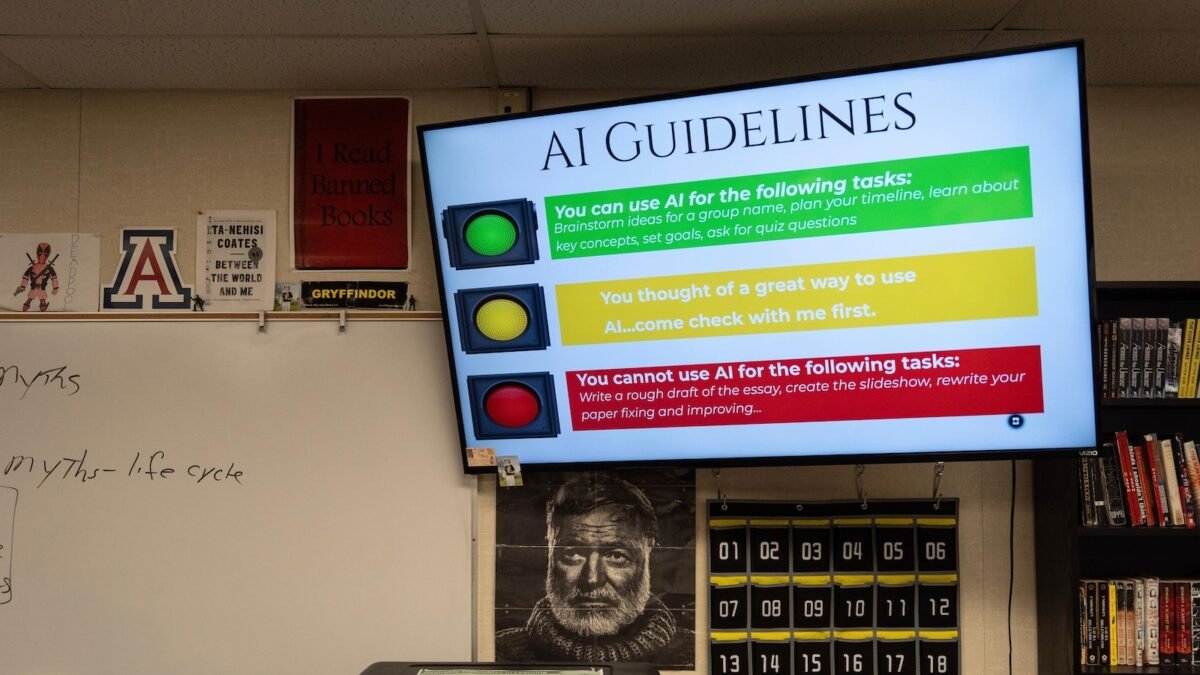
If you’re a parent, you’ve probably had the moment: you glance at your kid’s laptop and see them chatting with an AI about their homework, and you’re not sure whether to be impressed or alarmed. Should parents allow kids to use AI for schoolwork? The short answer is yes — but “allow” undersells your role. The real job isn’t permission; it’s guidance. Here’s how to think about it by age, and the conversations that matter most.
Should parents allow kids to use AI for schoolwork? The Honest Answer
Elementary (roughly under 10): co-use only
Young kids lack the judgment to verify AI output — and AI hallucinations are particularly dangerous for kids who can’t spot them. If AI is used, use it together: “let’s ask it to explain fractions and see if its explanation makes sense.” Model skepticism out loud. At this age, AI is a curiosity to explore with a parent, not a tool for independent work.
Middle school (10–14): supervised independence
Kids this age can start using AI for homework help with clear rules: AI explains, you write. Check in regularly — not by reading every chat, but by asking “show me something cool it taught you this week” and “did it ever tell you something wrong?” The second question teaches the critical lesson: AI makes mistakes, and spotting them is your job.
High school (14+): guided autonomy
By high school, the goal is judgment. Have the explicit conversation about the line between tutoring and cheating (see the cheating question), know the school’s policy, and shift from monitoring to mentoring. A high schooler who can’t use AI responsibly isn’t ready for college or work — this is the training ground.
The Conversations That Matter More Than Rules
Rules without understanding produce sneaky kids, not ethical ones. Have these talks:
- “AI is confident even when wrong.” Show them a hallucination live — ask the AI something niche and verify together. One demonstration beats ten lectures.
- “Your brain is the product.” Frame it positively: AI is a gym coach, not a forklift. The struggle builds the muscle; skipping it leaves you weak where it counts.
- “Tell me how you used it.” Normalize transparency. Kids who narrate their AI use (“it helped me outline, I wrote the rest”) develop the honesty habit that responsible use requires.
- “What did you learn?” The ultimate check. If they can’t answer, the AI did the learning, not them.
What to Actually Watch For
Don’t monitor every keystroke — watch for patterns. Warning signs: homework completed suspiciously fast with no understanding when asked about it, resistance to explaining their work, grades that don’t match their apparent knowledge, or anxiety when the AI is unavailable. These signal dependency, not just use. The fix isn’t punishment — it’s rebuilding the underlying skill with structured no-AI practice, the same approach behind healthy student AI use generally.
Also watch data privacy: kids paste personal information into chatbots without thinking. Teach them early — no real names, no school name, no photos, no personal details in AI chats. Make it a house rule like looking both ways before crossing.
Red Flags vs. Green Flags in Your Kid’s AI Use
Since you can’t (and shouldn’t) monitor everything, learn to read the signals. Green flags: your kid can explain their homework without the laptop open. They get excited telling you something the AI taught them. Their grades roughly match their demonstrated understanding. They ask you questions the AI couldn’t answer well. They use AI for some subjects but not others (selective use signals judgment). They show you funny or interesting AI mistakes unprompted — that’s a kid developing healthy skepticism.
Red flags: homework done in minutes with zero ability to discuss it. Panic or anger when the WiFi drops during homework time. A sudden, unexplained jump in writing quality that doesn’t match their speech or class participation. Avoidance — “don’t look at my screen” energy around schoolwork specifically. Grades high but test scores (no-AI environments) low — the classic divergence pattern. If you spot red flags, resist the interrogation impulse. Start with curiosity: “Walk me through how you did this one — I’m trying to understand the new tools.” Often the conversation itself reveals the pattern, and kids who feel approached rather than accused are far more honest. The goal was never catching them; it’s ensuring the learning is actually happening. And remember the strongest long-term play: kids who’ve internalized why the line matters (their brain is the product) police themselves better than any monitoring software ever could.
The Takeaway
Yes, allow it — with co-use for young kids, clear rules for middle schoolers, and judgment-building for teens. Focus on conversations over surveillance, watch for dependency patterns rather than usage itself, and teach privacy early. Your goal isn’t an AI-free childhood; it’s a child who grows into an adult with excellent AI judgment.
Resource: Common Sense Media offers age-specific AI guidance for families.



