
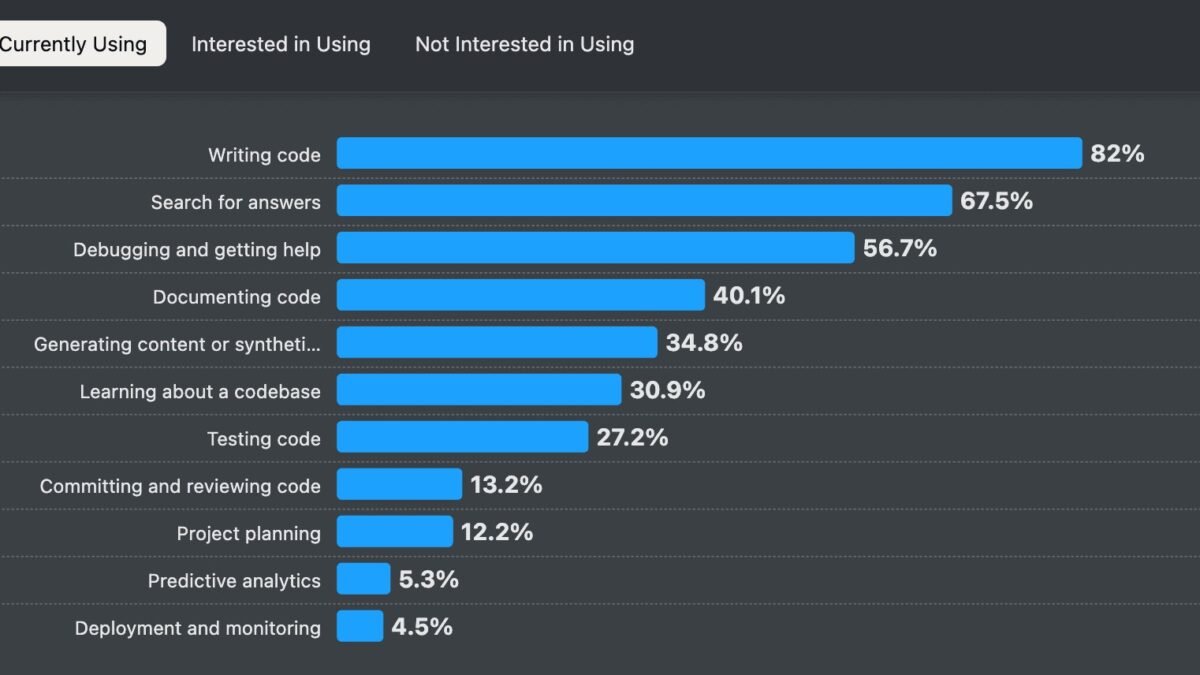
You’ve probably seen the viral claims: “AI writes 90% of my code now!” Then you look at actual engineering teams and the picture is messier. So how much code do developers write with AI now — really? Let’s cut through the hype with what surveys, studies, and working developers actually report.
How much code do developers write with ai now: The Full Breakdown
The honest range: for tasks suited to AI assistance, developers report AI contributing roughly 20–50% of the code they ship, depending on the work type. But that number needs serious unpacking:
- Boilerplate-heavy work (CRUD, configs, tests): 50–70% AI-assisted. This is where the tool earns its keep.
- Feature development in familiar stacks: 25–40%. AI drafts, human shapes.
- Novel systems, architecture, performance work: 5–15%. Here the human is the author and AI is a sounding board.
- Debugging: hard to measure in “lines,” but developers consistently call it the biggest time saver.
Why the viral numbers mislead
“AI wrote 90% of my code” usually means “AI generated 90% of the characters in a boilerplate-heavy side project I barely reviewed.” Lines of code is a terrible metric — it always was. What matters is who made the decisions. A senior dev might accept 200 lines of AI-generated test scaffolding while writing the 20 lines of core logic themselves. The AI “wrote” 90% of the diff and 5% of the thinking.
What This Means for Your Career
The developers thriving aren’t the ones maximizing AI-written percentages — they’re the ones using the saved time for higher-value work: design, review, talking to users. Professional developers use these tools as leverage, not crutches. And there’s a reason AI is so good at coding in the first place — code is structured, verifiable, and abundant in training data.
The number to watch isn’t “percent AI-written.” It’s “percent AI-verified.” Trusting AI code in production is a separate question from generating it, and the developers who last are the ones who review like the code came from a clever intern.
The Metric That Actually Matters
Let’s kill “percentage of code written by AI” as a metric and replace it with something useful: cycle time per feature. How long from “we need this” to “it’s in production, tested”? Teams using AI assistance well report 20–40% faster cycles on suitable work. That’s the number your manager cares about, and it’s the number that determines whether the tooling investment pays off.
The second useful metric: review burden. AI-generated code still needs human review, and review is the bottleneck. Teams that generate lots of AI code without scaling their review discipline end up with a different problem — a merge queue full of plausible-looking diffs nobody has truly read. The mature teams I know cap AI-generated PR size and require the author to annotate what the AI wrote versus what they wrote. Transparency in the diff makes review honest.
So when someone brags about 90% AI-written code, the right questions are: how fast are your features shipping, what’s your defect rate, and how thorough is your review? The teams winning with AI aren’t maximizing generation — they’re optimizing the whole pipeline from idea to production. Generation is one step in that pipeline, and not even the most important one.
How the Numbers Will Shift by 2027
Every trendline points one way: more AI involvement, not less. Models keep improving at multi-file reasoning, agents handle longer task chains, and tooling keeps absorbing verification steps (auto-running tests on generated code, for instance). The boilerplate percentage will keep climbing — 70% AI-assisted on routine work within a couple of years is a reasonable bet.
But watch what happens at the top end. As routine code gets cheaper to produce, the premium shifts further toward judgment: architecture, requirements, debugging the truly weird, and knowing what to build at all. The developers commanding the highest leverage won’t be the ones with the highest AI-generation percentage — they’ll be the ones directing fleets of agents toward the right problems. The metric of the future isn’t “how much did AI write” but “how much did you ship, and was it right.” Start optimizing for that now and the trendlines work for you, not against you.
What to do Monday morning: stop tracking AI-written percentages and start tracking cycle time. Pick one recurring task, measure how long it takes with AI assistance versus without, and let that number — not a viral tweet — guide your tooling decisions.
And remember the numbers cut both ways: a team shipping 40% AI-assisted code with rigorous review will outperform a team at 80% with rubber-stamp review every time. Generation volume is vanity; shipped quality is sanity.
The Takeaway
Expect AI to touch 20–50% of your shipped code on suitable tasks, near-zero on hard architecture. Optimize for decision quality, not generation volume — the leverage is in what you do with the time saved.
Background: GitHub’s research blog publishes solid studies on AI’s real productivity impact.



