
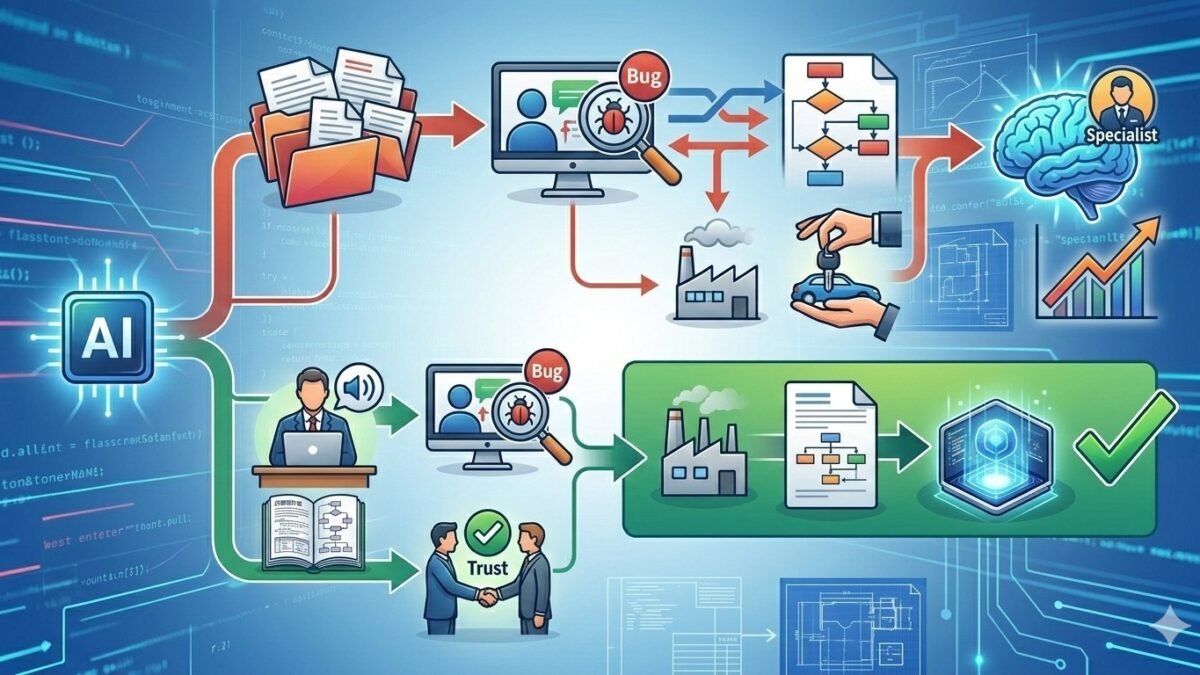
Somewhere in production right now, there’s code nobody fully understands — written by an AI, skimmed by a human, shipped on a Friday. Terrifying? A little. Avoidable? Completely. The question can AI-generated code be trusted in production has a real answer, and it’s not “never” or “always.” It’s: trust it exactly as much as you’d trust code from a smart, fast, overconfident junior developer. Then verify accordingly.
Can AI-generated code be trusted in production? The Honest Answer
Not all AI-generated code carries equal risk. Run it through these tiers:
Tier 1: Trust with normal review (low risk)
- Boilerplate, scaffolding, config files
- Test cases (which verify themselves by running)
- Documentation and comments
- Simple data transformations with clear inputs/outputs
Tier 2: Trust with extra verification (medium risk)
- Business logic — needs tests proving the edge cases, not just the happy path
- Database migrations — review every line; a bad migration is forever
- API integrations — verify against real docs, since AI invents fake APIs with total confidence
Tier 3: Don’t trust without expert review (high risk)
- Authentication, authorization, cryptography — ever
- Payment processing and financial calculations
- Anything where a subtle bug costs real money or real privacy
What Verification Actually Looks Like
“I’ll review it” is vague. Here’s concrete: tests with teeth (edge cases, not just happy paths), type checking and linting (catches a class of AI sloppiness automatically), security scanning (SAST tools don’t care who wrote the code), and for critical paths, a second human. Professional developers treat AI output like a pull request from a new team member — welcome, but reviewed. And stopping hallucinations is half the battle.
The liability question nobody asks
If AI-generated code causes an outage or a breach, “the AI wrote it” is not a defense — to your boss, your users, or a regulator. Your team’s review process owns every line that ships, regardless of origin. Build the process for that reality.
Incident Stories: What Goes Wrong in Practice
The failures are rarely dramatic — they’re mundane, which makes them instructive. The phantom API: a team shipped an integration using a library method the AI invented; it passed code review because the reviewer trusted the diff; it failed in production on the first real call. Lesson: registry-check every external call, no exceptions. The subtle logic bug: AI-generated date handling that worked in testing but broke on daylight-saving transitions — the kind of edge case a senior would have flagged from experience. Lesson: AI doesn’t have scar tissue; your review process must supply it.
The security hole: generated auth code that looked standard but skipped a validation step. It passed functional tests perfectly — security bugs usually do. Lesson: SAST scanning and security review for anything touching auth, always, regardless of author. The performance cliff: an AI-written query with an accidental cartesian join that was fine on 1,000 test rows and catastrophic on 10 million. Lesson: load-test AI-generated data code before it meets real volume.
Notice the pattern: every failure was catchable by a standard engineering practice — testing, review, scanning, load testing. AI doesn’t create new categories of bugs; it produces familiar bugs faster. The fix was never “don’t use AI.” It’s “don’t skip the practices that catch bugs, whoever wrote the code.”
Building the Review Checklist
Turn the trust framework into a concrete checklist your team actually uses on AI-assisted PRs. Origin labeled: the author notes which parts are AI-generated — no shame, just transparency. Tests present: edge cases covered, not just happy paths; AI-generated tests reviewed as carefully as the code. Dependencies verified: every external function checked against real docs. Security scanned: SAST run, secrets checked, auth paths human-reviewed.
Behavior confirmed: for refactors or conversions, output compared against the old version on real inputs. Rollback plan: exists and is understood, because even reviewed code fails sometimes. Make the checklist short enough that people actually use it — five to seven items max. The goal isn’t bureaucracy; it’s making the safe path the easy path. Teams with a checklist catch the phantom APIs and subtle bugs. Teams without one eventually star in an incident story.
Your next step: propose the review checklist at your next team sync. It takes one incident-free quarter for the checklist to pay for itself — and most teams adopt it permanently after the first phantom API it catches.
Remember the core principle: your review process owns every line that ships, regardless of who — or what — wrote it. Build the process for that reality and AI becomes an asset instead of a liability.
The Takeaway
AI-generated code can absolutely run in production — much of it already does. Trust it in tiers: boilerplate freely, business logic with tests, security-critical code only after expert review. The teams that get burned aren’t the ones using AI; they’re the ones who stopped reviewing. (And when you inherit AI-written code you don’t understand, AI can help explain legacy code — including its own.)
Standard to follow: OWASP’s secure coding guidance applies to AI-generated code exactly as it does to human-written code.




1 Comment