
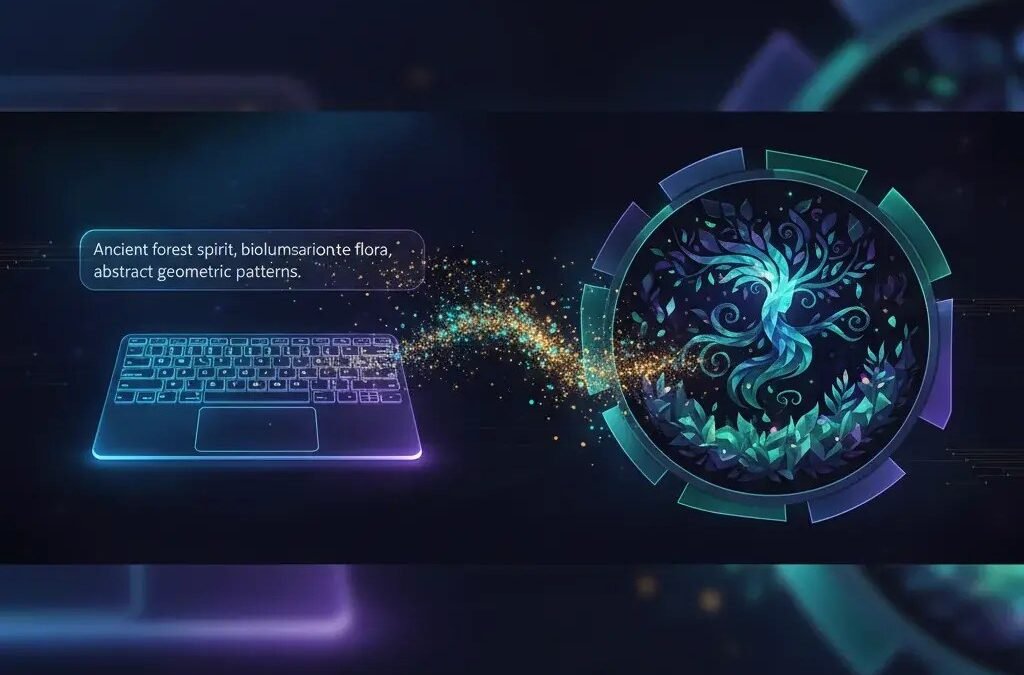
Here’s a mistake I see constantly: someone who’s great at prompting ChatGPT tries the same style on Midjourney and gets garbage. Or vice versa. How to write prompts for image generation vs text is really a tale of two completely different skills that happen to share the word “prompt.” The mental models are different, the techniques are different, and what works brilliantly for one fails comically for the other. Let’s untangle them.
The Core Difference
Text models (ChatGPT, Claude) understand language deeply — grammar, nuance, negation, abstract instructions. You can reason with them, give complex conditional instructions, and they’ll follow.
Image models (Midjourney, DALL-E, Stable Diffusion) match text to visual concepts statistically. They don’t “understand” your prompt the way a language model does. They’re more like very sophisticated mood boards that assemble visual elements. This changes everything about how you prompt them.
Prompting Text Models: Conversation and Precision
With text AI, you:
- Give context and background — the model reasons over it
- Use natural language instructions — “be concise,” “focus on X,” “don’t mention Y”
- Specify format precisely — headings, length, tone all work well
- Iterate conversationally — “make the second paragraph punchier” works because the model understands the reference
- Use negation freely — “don’t use buzzwords” is understood and followed
Our prompt structure guide is built for this world.
Prompting Image Models: Description and Weight
With image AI, the rules flip:
- Describe, don’t instruct. “A cozy cabin interior at dusk, warm lamplight, snow visible through windows, photorealistic” works. “Make me a nice picture of a cabin, and please make sure it’s cozy” doesn’t — the model doesn’t do “nice” or “please.”
- Front-load important elements. Words earlier in the prompt get more visual weight. Put the subject first, details after.
- Use visual vocabulary. Camera terms (85mm, shallow depth of field), art terms (oil painting, ukiyo-e), lighting terms (golden hour, rim lighting), quality terms (8k, highly detailed). This is a language you learn.
- Negation is unreliable. “No text in the image” often produces… text in the image. Image models struggle with negation — use negative prompts (the dedicated parameter) instead of writing “no X” in the prompt.
- Iterate with variations, not conversation. You can’t say “make the left side warmer” reliably — you remix, vary, and regenerate. It’s selection, not direction.
Side-by-Side Comparison
- Instructions: text models love them; image models mostly ignore them
- Negation: works in text (“don’t do X”); fails in image prompts (use negative prompt parameters)
- Length: text prompts benefit from detail and context; image prompts benefit from dense visual keywords (too much prose dilutes)
- Iteration: text = conversational refinement; image = generate variations and pick winners
- Examples: text models learn from pasted examples; image models use reference images (a different mechanism entirely)
Where They Overlap
It’s not all different. Both reward:
- Specificity over vagueness. “Victorian greenhouse” beats “nice building” in both worlds.
- Knowing your tool. Midjourney, DALL-E, and Stable Diffusion each have quirks — just like ChatGPT vs Claude. Our best AI image tool ranking and DALL-E guide help you pick.
- Studying what works. For text: analyze good prompts. For images: study prompts behind images you admire (many galleries show them).
How to write prompts for image generation vs text that actually work
The biggest mindset shift: text prompts are instructions; image prompts are descriptions. With text, you say “write a formal email about X.” With images, you describe what you’d see: “a red bicycle leaning against a brick wall, morning light, photorealistic.” You’re painting with words, not giving orders.
Image prompts reward concrete visual vocabulary: lighting (“golden hour,” “studio lighting”), composition (“wide angle,” “close-up”), style (“oil painting,” “35mm photograph”), mood (“serene,” “dramatic”). Each term steers the output; vague prompts get generic results.
What doesn’t transfer from text prompting: long logical instructions, complex constraints, “don’t do X” phrasing (image models handle negation poorly — say what you want, not what you don’t). Learn the visual vocabulary and your results jump a level. Midjourney’s documented prompt structure is the best reference for how descriptive prompting works.
Style references are the cheat code for image prompting: upload a reference image and ask for variations in that style. This beats describing styles in words — the model sees exactly what you mean. Combine a reference with a descriptive prompt for subject matter, and you get style consistency that pure text prompting struggles to achieve.
Finally, keep a prompt journal for image work: save the prompts behind your best generations alongside the results. Patterns emerge quickly — you will discover which descriptors, styles, and parameters consistently deliver for your taste. This personal reference becomes more valuable than any prompt guide.
The Bottom Line
How to write prompts for image generation vs text: text prompting is about clear communication — context, instructions, iteration through conversation. Image prompting is about visual description — dense keywords, front-loaded subjects, art vocabulary, and iterative selection. Learn both languages and you’ll be dangerous in both mediums. Confuse them and you’ll wonder why your beautiful paragraph produces an ugly picture.




1 Comment