
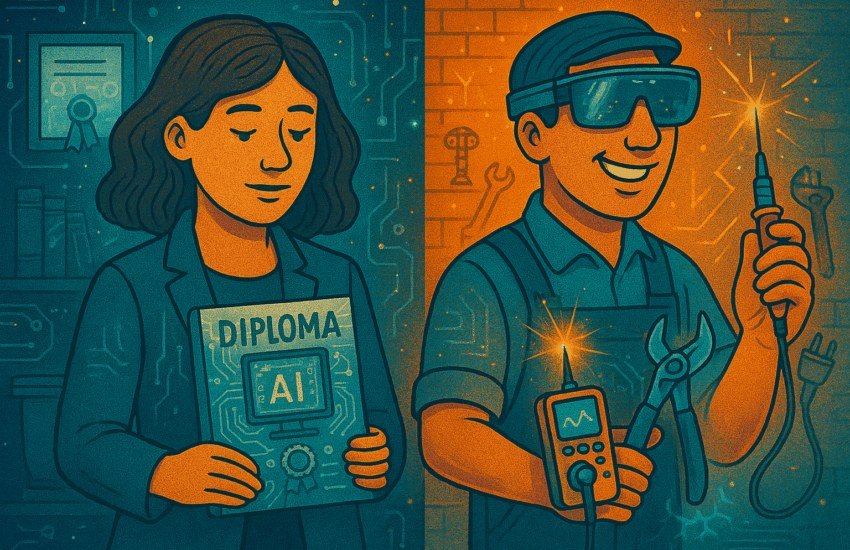
When AI can explain any concept, write any essay, and solve most textbook problems, the uncomfortable question sharpens: what is college for in the age of AI? If it’s just information transfer, we’re overpaying spectacularly. But college was never just information transfer — and the parts that matter most are the parts AI can’t replicate. Let’s be honest about what’s threatened, what’s safe, and what needs to change.
What is college for in the age of ai, Explained Clearly
The lecture as information delivery. A recorded lecture competing with an interactive AI tutor that answers your questions at your pace? The lecture loses on personalization every time. Lectures survive as performance, inspiration, and community — not as the primary knowledge channel. Routine assessment. Take-home essays and standard problem sets are now AI-completable. The credential value of “completed the coursework” erodes unless assessment changes. The signaling value of the degree alone. When everyone has a degree and AI can do degree-level tasks, employers look harder at what you can actually do — portfolios, projects, demonstrated skill.
Colleges coasting on prestige and lecture-halls are in trouble. But that’s not the whole story.
What College Is Actually For (The Durable Value)
1. Structured thinking development
The real product was never information — it was learning to think: constructing arguments, evaluating evidence, handling complexity, changing your mind. Done well, this happens through seminars, labs, studios, and mentorship — formats AI can’t replicate because they’re social and embodied. The colleges thriving are the ones doubling down on these high-touch formats.
2. The network and the coming-of-age
College is where 18-year-olds become adults among peers — friendships, collaborations, identity formation, independence. No AI replaces the roommate who becomes a co-founder or the professor who changes your trajectory. This sounds soft; economically, networks are among the highest-ROI parts of elite education.
3. Credentialing and sorting
Imperfect but real: degrees still open doors, especially first doors. The signaling value is evolving (toward demonstrated skill) but not gone. What changes: the degree alone suffices less; the degree plus portfolio matters more.
4. Deep expertise and research
Real mastery — the kind that lets you judge AI output rather than just generate it — still requires years of structured study. What to study matters here: depth in something real is the foundation AI fluency builds on.
5. Exploration with guardrails
College is society’s sanctioned space for intellectual risk-taking — trying philosophy as an engineer, failing safely, discovering what you care about. That exploration needs human community, not just information access.
What Needs to Change
Assessment must be redesigned — toward projects, orals, portfolios, and in-class work that AI can’t complete for you. AI literacy must be universal — every graduate should direct AI tools skillfully and verify rigorously (see student AI use). Teaching must shift from information delivery to thinking coaching — the seminar model over the lecture model. Career services must evolve — preparing students for AI-transformed workplaces, not 2019’s job market. The colleges making these shifts are becoming more valuable; those defending the lecture-and-essay model are becoming expensive anachronisms.
This connects to the broader curriculum adaptation happening at all levels.
Choosing a College in the AI Era: What to Look For
If you’re college shopping now, the AI question should be part of your evaluation — not the whole thing, but a real factor. Look for: AI literacy integrated into the curriculum (not just a computer science elective) — ask admissions directly. Assessment methods that go beyond take-home essays — project-based learning, undergraduate research opportunities, portfolios. Faculty who are visibly engaging with AI (check department pages, course descriptions). Career services that address AI-transformed workplaces, not 2019’s job market.
Look out for: institutions whose pitch is still “world-class lectures” (the most AI-disruptable format), no visible AI strategy (suggests institutional drift), and assessment that hasn’t changed in a decade. The deeper criteria still dominate: fit, community, specific programs, cost and debt load, graduation rates, alumni outcomes. AI readiness is a lens, not the whole decision. A college that’s thoughtful about AI but wrong on fit is still the wrong college.
And the cost question gets sharper: with information free and AI tutors available, the premium you’re paying must be justified by the human elements — mentorship, community, networks, structured challenge, credentials. Evaluate colleges on those specifically: what’s the student-faculty ratio in your major? What do undergraduates actually do (research? internships? projects)? Where do graduates actually work? The AI era doesn’t kill the college value proposition — it clarifies it. Choose the college that’s clear about its own.
The Takeaway
College in the AI age isn’t about information transfer — it’s about thinking development, networks, deep expertise, and guided exploration. The institutions thriving are redesigning assessment, teaching AI literacy, and doubling down on high-touch human formats. Choose your college (and your effort within it) for those things — they’re what the degree is actually for now.
Data: the National Center for Education Statistics — ground the college decision in real outcomes data.



